A clear look at the split between bank processing and casino account crediting, plus the checks that matter before paying.

A bank-based payment is a link between two separate records: money leaving an account you control and a balance being recorded in an online account. Those records do not live in the same place. Your bank handles the payment instruction; the gambling service handles the account balance. Seeing a payment move in one place does not, by itself, tell you what has happened in the other.
That distinction is easy to miss when a screen says “instant”. I used to read that as “everything is finished”. It is more accurate to think of it as a description of the transfer, not a promise about the whole service around it.
In Australia, PayID lets someone send money through a banking app using an identifier such as a mobile number or email address, rather than entering a conventional set of account details. A PayID payment is sent over the New Payments Platform, or NPP. In a casino-payment setup, the player initiates it from their banking app, and the service is meant to connect the incoming payment with the player’s online account. PayID deposits can arrive within seconds, often in the range of three to fifteen seconds.
That is the basic connection behind searches for bank-transfer pokies or online casino payments from an Australian bank account. The phrase can sound as though a bank has a special channel into a casino. It does not. There is a payment instruction, a receiving account or payment destination, and a separate process that associates the money with a customer record. The service’s account balance is not the same thing as the balance shown by your bank.
It helps to picture the movement in stages, without treating them as one seamless action. First, a payment is authorised in the banking environment. Then the payment network carries it to the receiving side. Separately, the online service must recognise the incoming funds and connect them to the relevant account. A delay or mismatch at that last point can mean the bank shows money sent while the online balance has not changed.
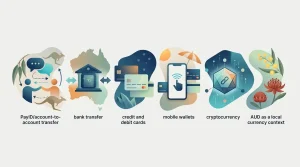 DV77 Payment Methods: PayID & AUD Cashier AustraliaDV77 Australia Guide DV77 supports AUD-oriented banking, PayID and bank transfer, credit and debit cards, Apple Pay, Google Pay and cryptocurrency. The…
 Casinos That Accept Apple Pay in AustraliaLearn how to assess Apple Pay claims, distinguish deposit support from withdrawal rules, and separate payment evidence from claims about games and…
That gap matters because the bank and the gambling service do not share one account ledger. The bank can confirm what happened to its payment instruction; it cannot decide how a third-party account is credited. Likewise, a balance displayed by an online service is its record, not a bank confirmation. Keeping those two views separate makes it easier to understand why a fast transfer and a credited balance are related but not identical.
The payment method also does not tell you what kind of gambling service sits on the other end. “Bank transfer” describes how money is moved; it does not establish that the service is lawful, safe, or available to Australians. That is not a small technicality. Under Australia’s Interactive Gambling Act 2001, providing real-money online casino games to people in Australia is prohibited. That includes services offering pokies, poker, and table games. A payment route does not change that legal position.
So I would not treat the presence of an Australian bank option as a stamp of approval. It only tells you something about the way a payment may be requested or received. It does not prove that the operator is authorised to offer casino gambling here, nor does it settle what happens to your money after it reaches the other side. Payment mechanics and legal status are separate questions.
People use “bank transfer” loosely. Sometimes they mean PayID, sometimes a conventional bank payment, and sometimes any option that starts in a banking app. Those methods should not be assumed to work in the same way. PayID uses an identifier and the NPP; a traditional wire relies on bank-account details and follows a different route. The general idea—money leaving one account and reaching another—is similar, but the steps and timing are not interchangeable.
The label “online casinos that accept bank transfer” can also blur the boundary between a payment feature and an endorsement. A payment button is not a guarantee that funds will be credited correctly, that a withdrawal will be handled in a particular way, or that the service complies with Australian law. It is simply one part of a transaction arrangement. The rest depends on the receiving service and its own account processes.
Attention: A payment button is not a guarantee that funds will be credited correctly or that the service complies with Australian law.
I have found it useful to stop reading speed claims as if they describe the entire experience. A transfer can move quickly while account records take a separate path. The banking app is one side; the service’s balance is another. Once that clicks, the phrase “bank transfer casino online” sounds less like a single product and more like a payment method being used between two systems.
The key idea is plain: PayID connects a banking-app payment to a receiving destination through Australia’s payment infrastructure, while the online service separately records funds against an account. That explains what the payment does, not whether a gambling service is lawful to use in Australia. Different question.
I can explain how PayID deposit screens are structured, but there is an important limit to that guidance in Australia: the Interactive Gambling Act 2001 makes it illegal for operators to provide real-money online casino games to people physically in the country. That includes pokies, poker and table games. So this is not a recommendation to fund an online casino account or a step-by-step invitation to do so.
In a payment flow described as a PayID deposit, the player selects PayID on the payment screen, enters an amount and then confirms the transfer in their banking app. The app is where the player authorises the payment; selecting PayID on a casino page by itself does not complete it. A displayed deposit amount is not the same thing as a bank-approved transfer, either.
That distinction matters when you are looking at claims about a “casino bank transfer deposit”. The payment screen may describe what it accepts, but it cannot change the rules set by your bank. PayID transaction limits are determined by the bank and vary between banks. Most major Australian banks permit individual PayID payments in the AUD 1,000–5,000 range, while their daily ceilings fall between AUD 10,000 and AUD 20,000. Your own account settings and bank’s rules are what matter; figures shown in a general description do not guarantee that a particular payment will be allowed.
There is a separate minimum on the receiving side. PayID deposits at casino services are commonly listed from AUD 10–20, while some bank-transfer offers state a floor as low as AUD 5. Those figures describe amounts an operator may accept, not a reason to send money. If a payment option displays a minimum that does not match the amount you intended to transfer, do not assume the app will adjust it safely. Stop and check what the screen is asking before authorising anything.
Small minimums can make a payment seem low-risk. That is not the same as making the service lawful or making the payment reversible. I would not let a low entry figure do the thinking for me. A number on a deposit page is only one condition, and it does not establish that an Australian-facing gambling service is permitted.
For an ordinary PayID payment, the banking app will show details for the transfer and ask you to confirm it. Read the amount and recipient information in the app rather than relying only on a page you left open elsewhere. If anything does not match what you expected, do not proceed. A transfer sent from a bank account is real money leaving that account, even if a separate website presents the transaction as a routine account top-up.
The practical question of “how much can I send?” therefore has two different answers: the bank controls the transaction and daily limits, while the receiving service sets any stated minimum or maximum for its payment option. Neither figure overrides the other. A requested amount can fit a site’s stated minimum and still be blocked by a bank limit; conversely, a bank may permit a transfer that the receiving service does not accept.
Do not try to work around a blocked payment by splitting it into repeated transfers or changing the amount without understanding the bank’s rules. The limits are account-specific, and a general range cannot tell you what your account will approve. Check your bank’s own PayID information for the applicable settings, and do not treat a successful transfer as proof that the destination is lawful.
A polished deposit flow can make a payment feel like a harmless app confirmation. It is still a financial transaction, and the legal status of the service matters before any money is sent. Keep those two points separate: the bank explains whether it can process a PayID payment; it does not validate the gambling service on the other end.
I used to treat a familiar payment logo as a kind of endorsement. It isn’t. PayID or bank transfer tells you how money might move; it doesn’t establish that an operator is legitimate, that its payout claims are reliable, or that it can lawfully provide casino games where you are.
That last point matters in Australia. Under the Interactive Gambling Act 2001, providing real-money online casino games to people physically in Australia is illegal for operators. A foreign licence does not override that rule or turn an offshore casino into a locally authorised service. So if a site advertises itself as the “best casino that accepts bank transfer” for Australians, I’d treat the sales pitch as something to test, not as a reason to sign up or send money. A payment option is not a licence.
A licence badge on a webpage is only a claim until you can match it to a regulator’s records. Check whether the named regulator exists, whether the operator’s legal name matches the one on its register, and whether the licence covers the activity being advertised. Read the regulator’s own information rather than relying on a logo or a casino’s description of its status.
For an Australian reader, there is an important distinction: confirming that an operator holds a foreign licence does not make offering real-money online casino games to people in Australia lawful. Nor should a site’s use of terms such as “regulated” or “licensed” be allowed to blur that distinction. Promotional language can be technically selective. That’s the catch.
A site can advertise fast withdrawals, but a headline is not a payout record. Look for specific, independently documented accounts of whether withdrawals were received and whether the operator explained delays or disputes. Separate reports about the operator’s handling of requests from claims about how quickly a payment network moves money; they are not the same thing.
I’d also notice what a complaint actually describes. A delayed payment could involve a pending identity check, missing information, an unresolved dispute or a transfer issue. A glowing testimonial that gives no detail is weak evidence; a pile of copied praise is not stronger because it is a pile. None of this proves what will happen to another person’s money, but it can show whether the site’s public promises are matched by a credible record.
Confirming that an operator holds a foreign licence does not make offering real-money online casino games to people in Australia lawful.
Don’t mistake a bank-transfer option for protection, either. It doesn’t settle questions about who operates the site, what rules apply to a transaction, or what happens if a payment is disputed. “Instant” describes a payment feature, not an assurance about the operator. I learned that one the expensive way.
Before trusting any statement about payments, read the operator’s terms and look for clear explanations of its procedures, including what it may ask you to provide and what could hold up a request. If the wording is vague, contradictory or hard to find, that is useful information in itself. Don’t fill gaps with assumptions just because the site looks polished.
A specialist review of casino payment practices reports that identity checks are commonly requested before a first withdrawal, and that completing KYC verification early may reduce paperwork delays. Treat that as a practical warning, not a promise that a particular operator will approve an account or pay out. Check what documents are requested and how personal information is handled before sharing anything.
The sensible test is not “Which casino looks best?” It is whether the claims can be verified, whether the terms are understandable, and whether the service is lawful for your location. In Australia, a polished page, foreign licence badge and bank-transfer button do not change the legal position. I wouldn’t send money on the strength of those signals.
If you’re looking for an Australian casino with instant bank transfers, check the available payment methods and processing terms before you deposit. Use this list as a starting point for reviewing each operator’s stated details.
Bizzo Casino
Bizzo Casino is listed with a license from the Curacao Gaming Control Board, held by TechSolutions Group N.V.
Playfina Casino
Playfina Casino is listed under Curacao eGaming, with Hollycorn N.V. as the license holder since 2017. Its minimum deposit is A$20–30, depending on the offer.
DragonSlots Casino
DragonSlots Casino is listed with a license from the Curacao Gaming Authority, held by Jumpman Gaming Ltd.
Wild Tokyo
Wild Tokyo has a Curacao license and a minimum deposit of A$10. Its stated payout speed is 30–60 minutes for crypto and 1–5 days for fiat.
JustCasino
JustCasino is listed with a license from the Curacao Gaming Control Board.
Roby Casino
Roby Casino is listed under Curacao eGaming, with Roby Games Ltd as the license holder.
Vegaz Casino
Vegaz Casino is listed with Curacao license number OGL/2024/1335/0780. Its minimum deposit is EUR 20.
Rollero Casino
Rollero Casino is listed with Curacao Gaming Control Board license OGL/2023/176/0095, held by Hollycorn N.V.
SkyCrown
SkyCrown is listed with a license from the Tobique Gaming Commission and a minimum deposit of A$30. Its stated payout speed is around 10–15 minutes for crypto and 1–5 days for fiat.
Golden Pokies
Golden Pokies is listed with a Curacao license.
“Instant” describes the movement of money through the payment network, not a promise that every step on a casino’s side happens at the same moment. In Australia, PayID works through the New Payments Platform (NPP), which allows participating bank customers to send and receive payments in real time using an identifier such as a mobile number or email address.
That distinction is easy to miss when a payment option is labelled “instant”. I used to read the word as a guarantee that the money would appear in the account immediately, end to end. It is more accurate to think of PayID as a fast payment rail: the transfer can settle in real time, while the service receiving it may still have its own process for recognising and recording it.
Two steps, not one.
PayID is an identifier-based service, rather than a separate bank account or a casino-specific wallet. The identifier points a payment towards the recipient’s account through the NPP. From the customer’s point of view, the transfer is made through their bank; the network handles the movement between accounts. The NPP was built for real-time payments within Australia’s banking system, so PayID is not simply a label for a traditional bank transfer that might take days.
That is the useful meaning behind “instant bank transfer” in Australia: the payment network can settle the transfer in real time. It does not mean that every business using PayID has identical systems, or that its own account records update at exactly the same instant. A receiving service may need to identify the incoming payment and apply it to the right customer record. Settlement and account credit are related, but they are not the same event.
When a bank transfer casino describes PayID as instant, read the claim narrowly. It refers to the speed of the underlying payment route, not necessarily to every part of the transaction after you have authorised it. If the money has left your bank but an account balance has not changed, that alone does not establish that the NPP transfer failed. The receiving service’s handling may be a separate matter.
I also keep the legal context clear: Australian law prohibits operators from providing real-money online casino games to people in Australia. Describing how PayID works is not an endorsement of using it to fund such services. The payment technology itself is a general banking service; the legality of a particular gambling service is a different question.
So the phrase casino instant bank transfer can sound broader than it is. PayID offers real-time settlement through the NPP, using a simple identifier linked to a bank account. “Instant” tells you something meaningful about the payment network, but it does not certify the recipient, the service, or the handling that follows. Keep those claims separate.
A bank-transfer withdrawal is not just a matter of entering an account number and waiting. The operator may ask for your bank details and documents to confirm your identity before releasing funds. I would treat those checks as part of the process, not as an annoying surprise after a balance appears on screen.
That does not make an online casino offer lawful in Australia. The Interactive Gambling Act 2001 prohibits operators from providing real-money casino games to people located here.
For a bank transfer, you may need to enter the account information requested on the withdrawal form. Make sure the account details are accurate and belong to you. A typo or a mismatch can leave a request waiting while the operator asks for clarification.
You may also be asked to submit documents for KYC verification. The exact documents depend on the operator’s process, so check its instructions rather than guessing what will be accepted. An operator may ask you to complete these checks before your first withdrawal. Getting the paperwork ready early can prevent an avoidable pause when you later try to withdraw.
I used to think verification was something to deal with only when a payment got stuck. That is backwards: if the request cannot be checked, the payment cannot simply skip ahead. Keep copies of what you submit and use the operator’s stated secure channel. Don’t send sensitive documents through an unverified contact method.
A casino may require you to withdraw through the same payment method you used to deposit, where that is possible. A specialist review describes this as a condition some operators apply, not a rule to assume applies everywhere. Read the cashier terms and withdrawal instructions before relying on a particular payout route.
If you deposited by PayID but the withdrawal page offers a bank transfer, check whether that is an allowed alternative or whether the operator expects the original method. Ask support for a clear answer if the instructions conflict. I would not make another deposit just to test a payout route; that only adds money to a situation you have not resolved.
Also check whose bank account can receive the funds. The details you provide should match the identity information the operator has verified. If something does not line up, get the discrepancy clarified before submitting the request.
The word “instant” can describe a payment network, not every step between a withdrawal request and money reaching an account. A specialist review gives a post-approval range of one to five business days for bank-transfer and card withdrawals. That is a reported estimate, not a promise for an individual request, and it does not tell you how long an operator may take to check documents or approve the withdrawal.
So separate the two things: the operator’s requirements and the bank’s transfer. Confirm the account details, finish KYC verification, and understand any method-matching condition before requesting payment. If the instructions are unclear, pause and ask for them in writing. Better than guessing.
“Instant” can describe a payment network, not the whole trip from a withdrawal request to money appearing in a bank account. PayID uses the New Payments Platform, which settles transfers in real time. But that rail only comes into play after the casino has reviewed and released a payout. The waiting often happens before that point.
A specialist review identifies the operator’s internal processing as the key bottleneck for PayID withdrawals, rather than the network itself. That distinction matters: a fast transfer cannot make a pending request move through an operator’s checks any sooner. I used to read a payment-method badge as if it were a delivery promise. It isn’t.
The same review describes a window of 0–6 hours for top-rated PayID casinos to accept withdrawal requests. That is a reported operator-side timeframe, not a guarantee that funds will reach a bank within that period. A separate specialist review puts the review and approval window at 2–6 hours for verified accounts. Those figures refer to different stages: one is request acceptance, the other is review and approval. Don’t add them together as though they were a firm countdown.
Verification status can affect what happens next. The quoted approval window applies to verified accounts; if the operator still needs information or documents, the request may not follow that timetable. Sorting out KYC verification ahead of a first withdrawal can help avoid paperwork becoming an extra hold-up. It does not force an operator to approve a request by a particular time.
After approval, the payment method matters again. The network can move a released PayID payment quickly, while bank transfers and card withdrawals may take longer after processing. A review of withdrawal timing reports that bank transfers and card withdrawals often take one to five business days after approval; that is a reported range, not a promise for every bank or operator. The clock on a casino’s review and the clock on a bank’s payment are separate.
If a request appears stuck, I’d first check whether it is still marked as pending review or has been approved and sent. Those are different problems, and asking about the wrong stage gets you a less useful answer. Then check whether any verification request is outstanding and ask support to confirm the request’s status and release time. Keep the response and transaction details.
There is a wider point for anyone in Australia: real-money online casino games are prohibited services when offered to people physically in the country under the Interactive Gambling Act 2001. This explanation is not a recommendation to use an offshore service. Where someone is examining a payment claim, the practical test is still whether it distinguishes operator approval from the transfer itself. “Fast payout” can hide two separate waits. Short version.
Legal Prohibition
Under the Interactive Gambling Act 2001, providing real-money online casino games to people physically in Australia is prohibited.
A bank payment method tells you how money moves; it does not tell you whether a bonus is fair, useful or even available to you. I have made the mistake of treating a headline offer as if it were money in my balance. It wasn’t. The conditions determined what I could do with it.
There is an important Australian legal context: the Interactive Gambling Act 2001 prohibits operators from providing real-money online casino games to people in Australia. An offshore promotion does not change that.
“Deposit by bank transfer” describes a payment route, not a bonus category. A deposit offer may be tied to a qualifying payment, while a “no-deposit bonus” is advertised as not requiring a deposit. Those labels don’t establish that an offer is available to Australian residents, or that its terms make it worthwhile. “Free” can mean a balance with strings attached.
If you are assessing the wording of an offer, start with the wagering requirement: how much qualifying play the terms demand before winnings can be withdrawn. Then check the maximum bet while the offer is active. A bet that exceeds the stated cap may affect eligibility or winnings, depending on the rules. Don’t assume that a game is eligible just because it appears in the lobby. Game weighting can mean different games contribute differently towards the requirement; pokies may not count in the same way as other games.
Next, look for the time limit and any maximum cash-out. A short expiry can leave little room to meet a requirement, while a cash-out cap may limit what can be withdrawn even after play. Read the full terms, not just the banner. I’ve learned that the banner is the bit designed to catch your eye.
The payment minimum is useful context, but it does not make a promotion good value. PayID casino deposits are commonly listed with minimums in the AUD 10–20 range; some bank-transfer options list a minimum as low as AUD 5. Those are payment thresholds, not proof of a bonus minimum or a promise that any offer applies. A promotion may set its own qualifying deposit conditions.
When you see language such as “instant bank transfer casino no deposit bonus,” separate the claims instead of treating them as one promise: payment speed, whether a deposit is required, and the bonus rules are different things. The terms should spell out eligibility, restrictions and what happens if a condition is missed. If they are vague or hard to find, that is reason to stop and reassess—not to send money first.
A conventional bank wire is a different kind of payment from PayID. It relies on account and bank details rather than an identifier such as a mobile number or email address, and it is not a quick-transfer option just because you arrange it online.
A wire instruction may ask for the recipient’s business name, bank account number and bank name. Depending on the transfer, it may also require SWIFT, BIC or IBAN details. You can arrange a wire in person at a bank, by phone, or online from a computer or mobile device. That range of channels sounds flexible, but the payment still has to travel through the banking process.
Uses an identifier (mobile/email) via the NPP for real-time settlement.
Relies on account details, may require SWIFT/BIC/IBAN, and can take up to seven business days.
The part I would not gloss over is the wait. A wire deposit may take as long as seven business days to show in an account. Charges are also possible, and they may be higher than fees on other non-banking transactions. “Direct” describes the route; it does not mean immediate or free.
There is an important Australia-specific point before considering any bank transfer casino real money payment: providing real-money online casino games to people in Australia is illegal for operators under the Interactive Gambling Act 2001. I’m not suggesting you send a wire to an online casino. The distinction matters because a payment label does not make a service lawful or turn a slow bank wire into PayID.
If you encounter wire details in another context, treat them as instructions to verify carefully with your bank before authorising a transfer. A long processing window can make a mistaken or disputed payment harder to sort out. Slow, and costly.
I’ve learned not to treat a payment screen as proof that the destination is legitimate. A familiar logo or a polished cashier page can still leave you sending money to the wrong recipient. In Australia, real-money online casino services are prohibited for operators under the Interactive Gambling Act 2001. I wouldn’t make a PayID payment to an offshore casino.
For any lawful PayID payment, check the recipient name shown in your banking app against the details you were given. Stop if the name is unexpected, the details have changed, or anything feels inconsistent. Don’t confirm a transfer just because a page says it is urgent.
The reference matters too. Some casino payment systems ask for a player ID or username so they can match a payment to an account. If that identifier is missing or entered incorrectly, the deposit may not be credited automatically; it can remain pending and need manual handling by support. That is not a reason to send another payment. First, keep the transaction record and contact your bank if you believe the recipient or instructions were wrong.
If you are reviewing a payment request, check both fields before proceeding: the recipient and the reference. A correct reference cannot fix a wrong recipient, and a correct recipient name does not guarantee that a payment will be credited to the intended account. I’ve made the mistake of rushing past the details. It is a bad habit.
PayID and a conventional bank transfer both move money through banking channels, but they identify the recipient differently. PayID uses an identifier, such as a mobile number or email address, and generally runs through Australia’s New Payments Platform (NPP). Once released, a payment can clear within minutes. That describes the payment rail, not any separate processing a service may do.
A bank wire relies on account details instead. For a casino deposit, those may include the business name, bank name and account number, with SWIFT, BIC or IBAN details requested in some cases. Wires can take up to seven business days to appear, and charges may be higher than for other non-banking transactions. More fields, more room for a typo. Not my favourite combination.
That is the practical difference behind comparing PayID with bank transfer: an identifier-based NPP payment versus a transfer arranged using formal bank-account details. The word “instant” can describe how quickly a PayID payment settles; it does not mean every service has finished handling it at that moment.
POLi is mainly a deposit method, so do not assume it can be used to withdraw funds. Visa and Mastercard are widely accepted for deposits, but card withdrawals depend on the processor and may be slower or unavailable. A payment method is not automatically a two-way street.
There is an important legal boundary here: under Australia’s Interactive Gambling Act 2001, operators cannot provide real-money online casino games to people physically in Australia. This comparison is about how payment methods differ, not an invitation to use an offshore casino. If you are assessing a financial transaction, know who the recipient is and what the payment channel actually does before sending money.
Yes, where the casino supports PayID withdrawals. The casino must approve the request first, and its review can take longer than the transfer itself.
Some services offer PayID withdrawals, but support is not universal. PayID availability does not mean an online casino is authorised to offer real-money gambling in Australia.
PayID is a payment method, not a guarantee that a casino is safe or lawful. Providing real-money online casino games to people in Australia is prohibited under the Interactive Gambling Act 2001.
Deposits commonly start at AUD 10–20, though some services accept AUD 5. Your bank sets PayID transaction limits; major Australian banks commonly allow AUD 1,000–5,000 per transaction and AUD 10,000–20,000 per day.
PayID casino deposits commonly start at AUD 10–20, with some accepting as little as AUD 5.
PayID payments can reach the receiving side within seconds, often around 3–15 seconds. The casino may take additional time to match the payment to your account, especially if the required payment reference is missing.
For verified accounts, some casinos review and approve requests within 2–6 hours; after approval, PayID payouts may arrive within minutes to hours. Bank-transfer and card withdrawals often take one to five business days.