The guide distinguishes operator restrictions from player liability and explains card verification, payment routes and withdrawal limits.

When you look for an online casino that takes a credit card, it is easy to let the payment question swallow the more important one: whether the service is allowed to offer casino gambling to people in Australia at all. The short version is that the law places the restriction on operators, not on players in the same way. That distinction matters, but it does not turn offshore gambling into a protected or recommended option.
The Interactive Gambling Act 2001 prohibits operators from providing online casino games to people physically located in Australia. That covers casino-style gambling such as poker, blackjack, roulette and pokies. An overseas location or licence does not remove the restriction when the service is being offered to customers here. The legal issue is the provision of the service to someone in Australia, not whether the website has a polished cashier or accepts a familiar card.
The Australian Communications and Media Authority, usually called ACMA, is responsible for enforcing the Act. Its role is not to certify an offshore casino as safe or to settle a dispute between a player and an operator. Enforcement is directed at prohibited interactive gambling services. Offshore casino access is also actively blocked and enforced against, so a website appearing in a search or loading at one moment should not be read as a sign that its service is lawful or endorsed.
If you’re looking for casino sites that accept credit cards in Australia in 2026, check the cashier for current card availability before depositing, as payment options can vary. Use this list as a starting point and consider each site’s stated licensing information.
Bizzo Casino
Bizzo Casino lists a license from the Curacao Gaming Control Board, with TechSolutions Group N.V. named in connection with it.
Playfina Casino
Playfina Casino lists a Curacao eGaming license held by Hollycorn N.V. since 2017. Its minimum deposit is A$20–30, depending on the offer.
DragonSlots Casino
DragonSlots Casino lists a Curacao Gaming Authority license, with Jumpman Gaming Ltd named in connection with it.
Wild Tokyo
Wild Tokyo lists a Curacao license and a minimum deposit of A$10. Its stated payout speeds are 30–60 minutes for crypto and 1–5 days for fiat.
JustCasino
JustCasino lists a license from the Curacao Gaming Control Board.
Roby Casino
Roby Casino lists a Curacao eGaming license held by Roby Games Ltd.
Vegaz Casino
Vegaz Casino lists license number OGL/2024/1335/0780 from Curacao and a minimum deposit of EUR 20.
Rollero Casino
Rollero Casino lists a Curacao Gaming Control Board license, number OGL/2023/176/0095, with Hollycorn N.V. named in connection with it.
SkyCrown
SkyCrown lists a Tobique Gaming Commission license and a minimum deposit of A$30. Its stated payout speeds are around 10–15 minutes for crypto and 1–5 days for fiat.
Golden Pokies
Golden Pokies lists a Curacao license.
There is a separate point about the player. The Act does not explicitly make it a crime for an individual to use an offshore casino. That is not the same as saying that every part of the experience is legally protected, or that a player has a practical route to recover money if something goes wrong. People often hear “players are not criminalised” and take away “there is no downside.” I would not make that leap. The operator’s legal position and the player’s consumer protections are different questions.
Australian consumer law does not protect players who use offshore casinos. If an operator refuses to pay, closes an account, or handles a complaint badly, you cannot assume that domestic consumer protections will apply simply because you are in Australia or used an Australian card. A familiar payment brand does not change the legal status of the gambling service, and it does not create a local safety net around the operator.
That gap is easy to miss because the website may look ordinary. It may have Australian-facing pages, show prices in Australian dollars, or present its cashier as if it were a local service. Those details tell you how the site presents itself; they do not establish that it may lawfully offer online casino games here. Nor do they tell you that a local regulator can resolve a dispute on your behalf. The interface can look reassuring. The protections may not be there.
So the phrase “casino sites that accept credit card Australia” describes a payment preference, not a legal category. Whether an offshore website says it accepts a card is not evidence that it is authorised to offer casino gambling to Australians. I would keep those questions apart: the payment method concerns what the site claims it can process; the law concerns whether the operator may provide the gambling service to someone in Australia. One does not answer the other.
This is why I would be wary of language such as “best” or “trusted” when it is attached to offshore casino recommendations. A ranking, review, or confident badge cannot substitute for legal consumer protection. It also cannot change the prohibition on operators offering online casino games to Australian residents. A site may be accessible for a time, and it may make claims about its own standards, but neither fact should be mistaken for approval by ACMA or protection under Australian consumer law.
The point is not to suggest that a player will face criminal prosecution simply for using an offshore site; the law does not explicitly criminalise that conduct. It is to be clear about what the law does say and what it does not provide. Operators are prohibited from supplying these services to people in Australia, ACMA enforces the Act, and Australian consumer law does not protect people who choose to use offshore casinos. Those are not small print details. They are the context for every later question about cards or payments.
Legal Warning
Australian consumer law does not protect players using offshore casinos, and the Interactive Gambling Act 2001 prohibits operators from providing these services to people in Australia.
I know payment pages can make the whole thing feel routine. You see a familiar logo and the transaction seems no different from any other online purchase. But the logo is not a legal shield, and a working payment route is not a sign that the underlying service is lawful here. That is the part I would want to understand before treating any offshore casino as an ordinary place to spend money. No easy reassurance.
An Amex deposit starts in the casino cashier. You choose American Express as the payment method, enter your card details and the amount in Australian dollars, then submit the transaction. That is the basic sequence; the amount you authorise is not always the only figure worth checking.
Before confirming, look at the payment summary and the casino’s payment terms for any charge added to the deposit. A specialist review has reported that a casino may apply a 1.5% surcharge to Amex transfers. Treat that as a possible operator-specific cost, not a standard fee attached to every casino credit card deposit. If a surcharge appears, it increases what is charged to your card without increasing the amount credited to your casino balance.
The currency matters too. Selecting an amount in AUD does not by itself establish that the casino will process the transaction in Australian dollars. If the payment is converted from another currency, a 3% conversion fee has been reported for Amex. That figure is not a universal charge for every deposit: conversion costs depend on how the payment is handled. Check the currency shown before you submit, and review the card account afterward so you can compare the transaction with the amount entered.
It helps to think of possible costs as separate layers. The casino may add a surcharge to the transfer; currency conversion may add a cost if the transaction is not processed in AUD. One does not cancel out the other. A deposit could face one, both, or neither, depending on the casino’s terms and the transaction currency.
A specialist review describes Amex deposits as typically fee-free, while also noting that charges depend on the casino. That should not be read as a promise that every deposit will be free. The practical check is the cashier’s displayed total and the payment terms, not a broad claim about what Amex deposits cost in general.
I learned the hard way that the number entered in a payment form is only one part of the transaction. If a screen shows a fee or a different currency, pause and work out what the card will actually be charged before submitting. “No fee” is a useful phrase only when the final amount confirms it.
For an online casino deposit with a credit card, keep the steps plain:
The amount in AUD gives you a clear starting point, but it does not answer every cost question. A surcharge is set by the casino, while conversion can depend on the currency used to process the charge. Those are different issues, so check for both rather than assuming one line in the cashier covers everything.
There is no useful “best credit card casino” shortcut in the payment form itself. A card deposit is a transaction with specific terms, not a badge of quality. I would focus on whether the amount, currency and any displayed charge are clear before authorising it. That small pause is better than trying to reconstruct the cost after the card statement arrives.
A casino credit card deposit can feel straightforward because the cashier asks for familiar details and an amount. But convenience does not make the cost structure automatic. The casino’s own terms determine whether it adds a transfer surcharge, and currency conversion may affect the final charge if the transaction is not in AUD. Where a specialist review cites a specific surcharge or fee, take it as a warning to check the terms for that payment—not as a rate that applies everywhere.
Card Deposit Process
Selection
Select Amex in the casino cashier.
Entry
Enter the card details and the deposit amount in AUD.
Verification
Check whether the cashier shows a surcharge or a currency other than AUD.
Submission
Submit the transaction only after the displayed payment details make sense to you.
The key habit is to compare the amount you intend to send with the amount and currency shown at the point of submission. If those do not line up, do not treat the difference as a harmless detail. A fee can be small on the screen and still matter when you are tracking what left your card.
Do the check first. Then decide.
A card appearing in a cashier is not a safety check. It tells you only that the site displays a way to attempt a payment; it does not establish that the operator is trustworthy, that your account has been properly assessed, or that a transaction will be approved. I used to treat a familiar card logo as a kind of reassurance. It wasn’t. A payment route and the safety of the place asking for your details are separate questions.
For Australians, that distinction sits inside a particularly important legal context. The Interactive Gambling Act 2001 prohibits operators from providing real-money online casino games to people in Australia. A foreign casino displaying a credit card option does not change that. Nor does a successful payment make the service locally regulated or bring it within Australian consumer protections. If you use an offshore casino, Australian consumer law does not protect you in the way it would when you deal with a local business. That is a reason to be cautious, not a recommendation to proceed.
Online casinos commonly require customers to pass a Know Your Customer assessment before they can carry out financial transactions. The point is that being able to open an account, or seeing a card payment option, does not mean the account has completed the checks the operator requires. The assessment is a distinct condition, and it may affect whether financial activity can go ahead.
That can be frustrating if you expected the cashier to be the whole process. It isn’t. A card can be listed and an account can exist, while verification remains unresolved. Don’t read the presence of an Amex or other card option as a signal that the operator has confirmed everything about your account. It only means the payment method is being presented as an option.
KYC Verification
Online casinos commonly require a Know Your Customer (KYC) assessment before financial transactions can be carried out, regardless of the payment method displayed.
I would not treat “verified” as a magic word either. It describes a check an operator requires; it does not certify the casino as safe, legal in Australia, or accountable to Australian consumer law. Those are different matters. A completed check does not repair the legal position, and it does not turn an offshore service into a locally protected one.
There is another decision-maker in the payment chain: the card issuer. Australian banks may block gambling-related transactions on Amex cards at the issuer level. So even if an online casino says it accepts credit cards, and even if Amex appears in its cashier, your bank’s policy can prevent the transaction from proceeding.
That is not a contradiction. The cashier’s displayed options and the issuer’s handling of a payment are not the same thing. Acceptance on a website is not a promise of approval by the bank. A decline can reflect an issuer-level block, rather than a problem with the card details you entered. It is sensible not to assume that trying again, or switching to another card, resolves the underlying concern.
Nor should a declined payment be treated as proof that the site itself is secure. It tells you that the transaction did not go through. The issuer’s decision does not amount to an endorsement of the casino, and a successful charge would not amount to one either. Payment approval is a narrow outcome, not a quality mark.
A credit card is a familiar financial tool, but familiarity can make a risky situation feel more ordinary than it is. The card brand may be recognisable; the operator may still be offshore, outside Australian consumer protections, and offering a service prohibited to operators under Australian law. Those facts do not disappear because the payment screen looks polished.
When I see a card option, I separate three questions in my head: does the cashier display it, will the issuer process it, and what protection applies if something goes wrong? The first two concern the payment attempt. The third concerns the relationship with the operator and the legal framework around it. Mixing them up is how a basic payment feature starts to look like reassurance it cannot provide.
That matters particularly when a site uses words such as “secure” or “verified”. Those labels can sound broader than they are. A verification assessment is an account check required by the operator; card acceptance is a payment facility offered on the site. Neither statement, by itself, demonstrates that an offshore casino is safe for an Australian customer or that Australian law protects the customer’s dealings with it.
So keep the meaning narrow. A listed card method does not promise approval. A bank may block the transaction. An account may still need to pass the operator’s KYC assessment before financial transactions are allowed. And none of those payment-related steps changes the legal status of online casino services offered to people in Australia.
Not a safety badge.
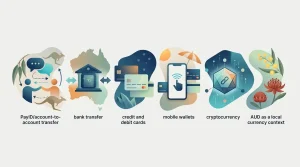
In Australia, paying by tapping a card has become ordinary: contactless credit and debit cards are accepted in almost every part of day-to-day commerce. Mobile wallets such as Apple Pay and Google Pay have similarly broad acceptance. That familiarity can make it tempting to assume that any online service will offer the same choices. I would not make that leap. How Australians pay in shops does not establish which payment methods an online gambling service accepts, or whether it may lawfully offer casino games to people in Australia.
People here are also accustomed to moving between payment types. A card might be the first choice in one situation, a phone wallet in another, and a bank-linked service such as PayPal elsewhere. That flexibility is part of the broader payment landscape, not evidence that these routes work at a particular gambling site. Availability depends on the service and its rules; familiarity at the checkout tells you little about a separate online transaction.
This distinction matters when you are weighing up a card payment against the idea of playing without a credit card. The phrase “more choice” sounds reassuring, but it can conceal a simple difference: Australians may have a wide range of ways to pay in everyday life, while an online casino’s cashier is not the same thing as a shop checkout. A familiar wallet or bank-linked service should not be treated as a workaround or as proof that a gambling transaction is permitted.
I have found it useful to separate three questions that get bundled together: what Australians commonly use, what a particular service displays as a payment option, and what the law allows. The first is about habits. The second is about the service’s own payment arrangements. The third is not settled by a card logo or a wallet button. They are different things. Easy to muddle.
So, if you are comparing card-based payments with other ways Australians pay online, keep the comparison at that level. Contactless cards and mobile wallets are widely accepted across Australia, and people are comfortable switching between cards, wallets and services linked to their banks. Those facts describe the country’s everyday payment habits. They do not amount to a recommendation to gamble, a claim that a casino accepts a particular method, or reassurance that an online casino transaction is protected.
A payment method can feel familiar because you use it elsewhere; that feeling is not a substitute for checking what the transaction actually is. “Seamless” is the sort of word that can blur the distinction. What it means in practice is only that a payment method fits into a routine—not that it changes the status of the service receiving the payment. For Australian readers, that boundary is worth keeping clear.
The same goes for a search for a casino that takes credit cards or one that does not require a card. Those descriptions focus on the method, but the method is only one part of the picture. General acceptance of cards, mobile wallets and bank-linked services in Australia cannot tell you whether an online casino is lawful, whether a payment will be available, or whether consumer protections apply. Convenience in one setting does not carry over automatically to another.
A specialist review has reported that Visa may be accepted by more Australian online casinos than Amex. That is a narrow comparison of reach, not a dependable rule for every operator. It does not mean Visa will be available wherever you look, or that Amex will be refused at any particular site.
I would treat “top credit card casino” claims with care. A broad label can make payment options sound uniform, when the relevant detail is whether a specific cashier lists your card. A comparison between Visa and Amex says nothing by itself about an individual operator’s current payment arrangements. Nor does it establish that a listed card will complete a transaction.
Attention: The fact that Visa may have wider acceptance than Amex is a broad comparison and not a guarantee that a specific card will be accepted by any particular operator.
The wording matters: Visa *may* have wider acceptance. It is not a promise, a ranking, or a guarantee. The reported difference is between the two card networks’ reach across Australian online casinos, not between the quality or safety of those services. A wider footprint should not be read as an endorsement.
That distinction can get lost in pages advertising a “top credit card online casino”. The phrase sounds like a settled category, but the card comparison alone cannot identify a best option. It only points to a possible difference in how often the two payment methods are offered. I would not turn that into a recommendation to use either one.
For you, the practical takeaway is modest: Visa may appear in more cashiers than Amex, while acceptance still depends on the operator. Don’t infer universal access from a general comparison. And don’t read a payment logo or a card option as proof that an offshore casino is safe or legally authorised to serve people in Australia.
I’ve learned not to treat a neat payment label as the whole story. “Accepted” can sound like a firm answer, but a general comparison cannot tell you whether a particular site lists that card or whether a transaction will go through. The reported Visa advantage is useful only at that broad level.
So if you are comparing card options, keep the claim in proportion: Visa may have broader reach; Amex may have less. That is all this comparison supports. It does not name a leading casino, settle which card is preferable for you, or promise that either will be accepted in a particular cashier. A small distinction, but an important one.
A credit card casino offering real-money play may make the payment step look like the main hurdle. It is not. Online casinos typically require customers to complete a Know Your Customer (KYC) assessment before they can make financial transactions. Paying by card does not remove that requirement, and the real-money label does not change the legal position in Australia.
KYC is a check on who is using an account. In practice, it means an operator may pause financial activity until the assessment is complete. That can matter even when a payment appears straightforward: the cashier accepting a card does not mean the account has cleared the operator’s checks. I used to treat a payment screen as a kind of green light. It isn’t. A submitted transaction and a completed account assessment are separate things.
There is another distinction worth keeping clear. The Interactive Gambling Act 2001 prohibits operators from providing real-money online casino games to people in Australia. The law does not explicitly criminalise an individual player for using an offshore site, but that is not the same as saying the service is lawful or protected. Australian consumer law does not protect players who use offshore casinos.
So when you see a site described as an online casino that accepts credit cards for real money, read that as a statement about a payment option—not as proof that the service is authorised in Australia, that an account will pass KYC, or that a transaction will go through. Those are different questions, and none is answered by the presence of a card logo.
The checks can also affect when financial activity is allowed. Since casinos typically require KYC before financial transactions, a player may encounter the assessment before being able to proceed. It is sensible to understand that condition before treating a deposit option as the whole process. No shortcut.
Paying with Amex and receiving a payout to Amex are separate steps. A cashier can accept a card deposit without offering that same card as a withdrawal route. That distinction is easy to miss when you are focused on getting money into an account; it matters more when you want winnings sent back.
A specialist review reports that some casinos may not allow withdrawals to Amex, while others may attach an extra fee to the withdrawal. Those details are specific to the operator and its payment rules, not a general promise that a card used for depositing will also work for cashing out. Read the withdrawal terms as well as the deposit options.
There can also be a prior-use condition. For an Amex withdrawal, the player must have already made a deposit with Amex. In other words, adding the card as a payout method on its own may not satisfy the requirement. If you have not deposited that way, the casino’s rules may prevent an Amex cash-out.
Timing is another point to keep separate from the deposit process. A specialist review gives a clearing period of up to five days for Amex casino withdrawals. Treat that as a reported possibility, not a guaranteed arrival date: processing and clearing are different stages, and the casino’s stated terms govern the transaction. “Fast payout” is vague wording; it does not tell you whether a card withdrawal is available or how long it may take to clear.
Before relying on an online casino payout to a credit card, check whether Amex is listed for withdrawals, whether a previous Amex deposit is required, and whether a fee applies. The answers can differ from the deposit rules. A successful deposit settles only the payment going in. It does not establish that the casino will send money back to the same card.
That gap is the part worth noticing before a balance becomes a withdrawal request. A card can be accepted on the way in and still be unavailable on the way out. No assumption carries across.
American Express deposits are listed as an option at some Australian-facing online casinos, but that does not mean every casino takes Amex. A specialist review of casino payment methods reports that acceptance varies between operators. Treat that as a snapshot, not a standing promise: payment options can change, and a general description cannot confirm what a particular cashier offers now.
“Accepted” can sound more definite than it is. At most, it tells you that Amex may appear as a deposit method at some casinos. It does not establish that the card is available everywhere, or that every casino accepting credit cards includes Amex among them. The wording matters. A broad claim about credit cards is not the same as confirmation of American Express specifically.
I’ve learned not to read a payment logo as a guarantee. A logo or review can be a clue, but it is not proof that the option will be present when you check. A specialist review has also noted that some online casinos do not accept Amex; because that information can become outdated, it is better understood as a reported limitation than a permanent rule for the whole market.
There is no single acceptance pattern to assume across Australian-facing sites. One casino may list Amex while another does not, and a general label such as “credit card accepted” leaves the card brand unclear. If a payment method matters to you, look for an explicit Amex listing rather than inferring it from a generic card reference.
That distinction is the useful one: some casinos are reported to offer Amex deposits, while others are reported not to accept the card. Neither statement identifies a particular operator’s current cashier. Offshore casino services are not a recommendation; Australian consumer law does not protect people who use them. Check the legal context before treating a payment option as a reason to proceed.
If you are comparing ways to pay without a credit card, the main trade-off is between speed and cost. Cryptocurrency payments, including Bitcoin and Ethereum, can provide instant deposits and withdrawals, with limited or no fees. That sounds tidy on paper. In practice, the relevant terms depend on the service handling the payment, so “instant” should not be read as a promise that every transaction will be immediate.
Bank transfers are a different proposition. A specialist review describes them as potentially slower and more expensive than crypto payments. That is a possibility, not a fixed rule: transfer timing and charges can depend on the banks and services involved. Check the terms before relying on a particular route.
I used to focus on the headline speed and ignore what could be charged along the way. Bad habit. A payment method can look cheap at the point of sending money while still involving costs elsewhere, and a quick transfer does not tell you whether the rest of the arrangement is safe or lawful.
So, if you are weighing an online casino without a credit-card payment, compare the stated fees and processing conditions for each method rather than assuming one option is automatically better. Crypto may be faster and carry limited or no fees; a bank transfer may take longer and cost more. Those are broad trade-offs, not guarantees for a particular operator or transaction.
A deposit that goes through can appear immediately, but that does not mean every attempt will be approved. A specialist review reports that Amex may decline a payment when it blocks transactions to a particular website. That is different from a slow transfer: the card issuer has refused the payment, so waiting may not resolve it.
I used to read a declined payment as a temporary glitch and keep trying. That can turn a simple refusal into a confusing string of errors. The useful distinction is whether the transaction was accepted but has not appeared, or whether Amex rejected it. If the cashier gives you a clear decline message, repeated submissions are unlikely to clarify what happened.
If the status is unclear, check the transaction record and contact Amex through its official support channel before attempting anything else. The casino’s cashier may show a failed or pending transaction, but that alone does not tell you why it happened. Don’t assume that a card working elsewhere means it will work with a particular website.
Payment timing also needs careful wording. A specialist review describes successful Amex casino deposits as being processed instantly. That refers to a completed transaction, not a promise that every payment will be accepted or displayed without delay. A decline is a separate outcome, and an issuer-level block may be the reason.
There is no clever workaround in guessing. A declined card payment is not evidence that another attempt will succeed, nor is it a sign that the website is safe to use. Check what the issuer says, and avoid treating a fast deposit as reassurance about anything beyond the transaction itself.
Yes, at casinos that accept American Express, but gift cards can be used for deposits only.
Some online casinos accept American Express, though Australian banks may block gambling transactions and Amex may block payments to particular sites. Australian law prohibits operators from offering online casino games to people in Australia.
Limits are set by each casino and can vary; Amex limits are usually higher than those for Mastercard or Visa. Check the casino’s cashier or payment terms for its current limits.
Amex deposits are typically free, but a casino may add a 1.5% surcharge, and a 3% currency conversion fee may apply. Withdrawals may also incur a fee.
Amex deposits typically have no fee, but check the payment summary: a casino may add a 1.5% surcharge, and currency conversion may incur a 3% fee.
Yes, Amex deposits are processed instantly. Withdrawals can take up to five days to clear.