DV77 Payment Methods Australia: AUD, PayID, Cards and Crypto
 Available in US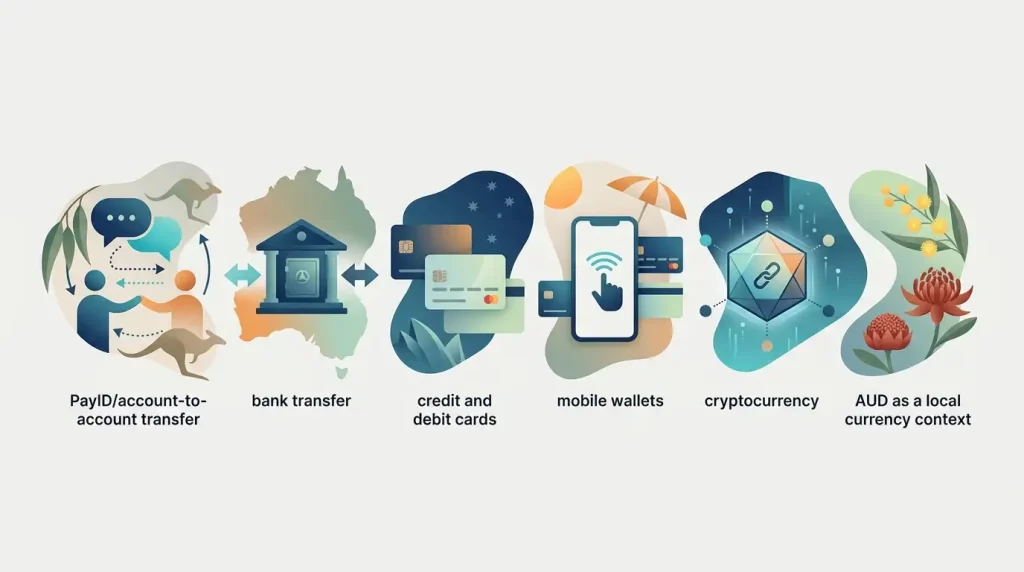
DV77 supports AUD-oriented banking, PayID and bank transfer, credit and debit cards, Apple Pay, Google Pay and cryptocurrency. The exact methods visible in a cashier can still depend on the account and payment provider. A supported category does not by itself establish a current fee, transfer time, transaction limit or identical deposit and withdrawal availability.
For Australians, PayID has clear local relevance because it is a familiar account-to-account payment service, while cards remain the country’s most widely used consumer payment method. Crypto is available at DV77, but general Australian payment data shows it is used far less often than cards or PayID. Cashout details are covered in the DV77 withdrawal guide.
Table of Contents
- DV77 payment methods
- Why PayID is especially relevant to Australian readers
- Cards are still the Australian baseline
- Crypto is supported, but it is not a mainstream Australian payment habit
- Cashier minimum and bonus minimum are different facts
- A practical payment-method checklist
- Why account-detail matching matters before payment choice
- Payment support does not equal Australian authorisation
- DV77 and Australian payment context
- Australian payment behaviour in 2025
- PayID familiarity does not guarantee casino cashout behaviour
- Cards and mobile wallets can overlap
DV77 payment methods
DV77 presents AUD-oriented banking for its Australia-facing service. PayID and bank transfer are supported for deposits, while credit and debit cards, Apple Pay, Google Pay and cryptocurrency are listed as payment categories. These are category-level details, not promises about a particular transaction.
| Payment category | Current position | What still needs a live cashier check |
|---|---|---|
| AUD banking | DV77 provides AUD-oriented payment access for its Australia-facing service. | The exact settlement path, bank-side treatment and any current transaction charge. |
| PayID and bank transfer | PayID and bank-transfer deposits are listed among DV77 payment options. | The exact label shown to an account, whether the option is available for withdrawal, and any provider-specific timing. |
| Credit and debit cards | Cards are supported as a payment category. | Which card networks are accepted for a particular account and whether a card can receive a cashout. |
| Apple Pay and Google Pay | Both mobile wallets are listed among DV77 payment options. | Account, device and payment-provider availability at the time of use. |
| Cryptocurrency | Cryptocurrency payments are supported as a category. | Which assets and networks are available, the current exchange handling and any transaction-specific limits. |
A supported category is a starting point, not a promise of immediate processing, fee-free transactions or identical deposit and withdrawal support. Those conditions can vary by account, payment provider and transaction.
Why PayID is especially relevant to Australian readers
PayID deserves attention because it is not an obscure casino-specific payment label. The Reserve Bank of Australia’s 2025 Consumer Payments Survey, released in May 2026, found that around 80 percent of respondents were aware of PayID and around 50 percent had used it in the previous year. That makes PayID a widely recognised Australian account-to-account payment service. The same RBA work explains that PayID lets users address a payment with a phone number, email address or Australian Business Number rather than manually entering bank account details.
PayID support gives DV77 compatibility with a payment service that is widely used in Australia. That familiarity does not establish Australian licensing, guarantee an instant transaction or determine how a bank will treat every gambling-related transfer.
The RBA also notes that PayID shows the recipient’s name before payment, which can reduce the risk of misdirected payments. For DV77, users still need to follow the account-specific payment instructions shown for the transaction.
For broader regulatory context, see the Australian licence context. Payment availability and Australian authorisation are separate questions.
Cards are still the Australian baseline
Cards remain the most widely used consumer payment method in Australia. The RBA’s 2025 survey found cards accounted for about 73 percent of consumer payments, with debit cards alone accounting for roughly half. For a DV77 payment comparison, that explains why card support is locally familiar even before looking at casino-specific preferences.
A card can be accepted for a deposit while being unavailable for a withdrawal, depending on the provider and account. Banks can also apply their own controls, and the current cashier can differ from general payment descriptions. Card deposits should not be assumed to be instant, free, reversible or universally eligible for cashout.
Mobile wallets sit on top of that broader card ecosystem for many consumers. RBA data shows device-based payments continued to grow in 2025. DV77 lists Apple Pay and Google Pay among its payment options, which makes those methods relevant for users who already store cards in mobile wallets. The practical distinction is availability and account compatibility; one wallet should not be assumed to be automatically faster or cheaper.
Crypto is supported, but it is not a mainstream Australian payment habit
DV77 supports cryptocurrency as a payment category, while Australian consumer use of cryptocurrency is a separate context. In the RBA’s 2025 survey, about 66 percent of respondents were familiar with cryptocurrency as a payment method, but only around 2 percent had used cryptocurrency to make a payment in the prior year. Crypto therefore has high awareness but low general payment use compared with cards and PayID.
Crypto support at DV77 does not make cryptocurrency a mainstream Australian payment habit. Users may still need to consider network selection, asset volatility, wallet handling and whether the same route can be used for cashout.
If a crypto transaction involves an exchange rate, conversion spread or network fee, the amount depends on the current account and provider terms. No generic conversion or fee assumption is applied.
Cashier minimum and bonus minimum are different facts
A cashier minimum and a promotion-qualifying minimum are not the same thing. A cashier minimum is the lowest amount the payment system currently accepts for a deposit. A promotion-qualifying minimum is the amount that may be required to activate or remain eligible for a specific bonus. They can change independently.
A promotion-specific deposit threshold is not the same as a general cashier minimum. Bonus conditions belong with the bonus terms, while ordinary payment limits depend on the cashier and account conditions.
The same separation applies to wagering and cashout rules. A deposit can be accepted successfully and later be connected to promotion conditions that affect when funds become withdrawable. That does not change the payment method itself; it changes the account conditions attached to the balance.
A practical payment-method checklist
Before treating any DV77 payment option as suitable for a particular account, check the factors that can change how the method works in practice:
- Is the method actually visible? Category support does not guarantee the same cashier menu for every account.
- Does the payment name match the account name? DV77’s terms require accurate account details, and payment information that does not match can create verification or transaction issues.
- Is the method deposit-only or also available for withdrawal? Do not assume symmetry.
- What minimum is being shown? Separate the cashier transaction minimum from any bonus-qualifying deposit.
- Are there provider or bank charges? Fees can depend on the payment method, bank or provider, so no universal zero-fee rule is stated.
- Does a promotion change the balance conditions? Deposit acceptance and bonus withdrawal eligibility are different questions.
- Will verification be required before cashout? DV77 requires identity verification before withdrawals, so payment convenience does not remove the KYC step.
For account details and identity checks, see account verification. For the wider DV77 context, return to the DV77 Australia review.
Why account-detail matching matters before payment choice
DV77’s terms require registration details such as a full legal name, date of birth, email, phone number and address, and they require users to use their true identity. That makes payment-method comparison partly an account-data question. A familiar method is not especially useful if the payment details conflict with the identity information held on the account and later create a verification problem.
For that reason, method choice should be evaluated across the full account cycle rather than only at the deposit screen. The relevant checks are whether the method is offered to the account, whether the payment ownership details are consistent, whether the route can support a later withdrawal, and whether KYC will require additional confirmation before cashout. These are operational checks, not reasons to deposit.
A broad list of payment logos is less informative than the account conditions attached to a transaction. Method availability, account-name matching, deposit eligibility and withdrawal support can differ even within the same payment category.
Payment support does not equal Australian authorisation
DV77’s payment set combines locally familiar options such as AUD banking, PayID and cards with mobile wallets and cryptocurrency. The method actually shown to an account can still depend on the cashier and payment provider, so category support does not guarantee identical fees, limits, timing or withdrawal eligibility.
Deposit and withdrawal speed, fees, limits and method availability can vary by transaction and account. Exact cashout timing and limits belong with the dedicated withdrawal information rather than being treated as universal payment facts.
DV77 has a broad payment set, PayID is locally familiar in Australia, cards dominate Australian consumer payments, and crypto is supported but remains uncommon as a general payment method. The practical question is which method is available to the account, under what conditions, and whether the same route supports withdrawal.
DV77 and Australian payment context
- DV77 deposit guide for current payment-category information.
- DV77 FAQs for current AUD-oriented payment and account-availability wording.
- Reserve Bank of Australia, Consumer Payment Behaviour in Australia for the 2025 Australian payment-use context.
Australian payment behaviour in 2025
The RBA’s 2025 Consumer Payments Survey provides useful context for the methods named by DV77. Cards made up around 73 percent of consumer payments, with debit cards accounting for roughly half of all payments. PayID awareness reached around 80 percent and around 50 percent of respondents had used PayID in the previous year. Mobile-wallet use also increased, with 43 percent of consumers using a mobile device for a contactless payment during the diary week.
Cryptocurrency was much less common as a general payment method. Around 66 percent of respondents were familiar with cryptocurrency as a payment technology, but only around 2 percent reported using it to make a payment in the prior year. DV77’s crypto support therefore adds a payment category, but the Australian survey does not support treating crypto as a mainstream local payment habit.
PayID familiarity does not guarantee casino cashout behaviour
PayID’s broad use in Australia makes it a familiar payment reference, but the RBA data describes consumer payments generally rather than DV77 withdrawal performance. A familiar deposit route should not be assumed to carry the same fee, timing or cashout availability on every account. The DV77 cashier and withdrawal screen determine the method conditions that apply to the transaction.
Cards and mobile wallets can overlap
DV77 lists credit and debit cards alongside Apple Pay and Google Pay. A mobile wallet can use a card already stored on the device, but cashier availability still depends on the account and payment provider. A wallet shown for deposits should not automatically be assumed to use the same route for withdrawals.