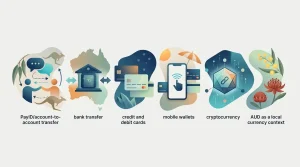
A guide to offshore operators, accepted currencies, Australian legal limits, and the claims about bonuses and identity checks that could not be confirmed.

An offshore crypto casino uses cryptocurrency as a way to move funds into and out of an online gambling account. The basic idea is straightforward: you hold digital assets in a wallet, transfer an accepted currency to the account, and use the balance for gambling. If you later request a withdrawal, the funds are sent back as cryptocurrency. The moving parts are familiar; the important detail is that each operator decides which currencies it accepts and how it handles them.
Bitcoin and Ethereum are supported by almost all crypto casinos. Tether (USDT), Litecoin and Ripple are also commonly accepted, alongside other altcoins. Stablecoins such as USDT are designed to track a conventional currency, while Bitcoin and Ethereum can change in value against the Australian dollar. That difference matters when you think about what a balance represents. A number shown in a casino account is not necessarily a fixed Australian-dollar amount.
I used to treat “crypto accepted” as if it meant every coin would work everywhere. It doesn’t. A site may take Bitcoin and Ethereum but not the asset you happen to hold; another may support a different mix. Offshore casinos commonly accept Bitcoin, Ethereum, stablecoins and a range of other cryptocurrencies, but that broad pattern is not a promise about any particular account. Check the currency options displayed by the service itself before you make a decision.
The process can look deceptively tidy on screen. You choose a currency, the account presents payment instructions, and you arrange a transfer from your own wallet. Once credited, the balance may be used for gambling. But the screen is only one part of the arrangement: your wallet, the casino account and the blockchain are separate pieces. A transfer leaving your wallet does not by itself tell you what the operator will credit, or when. Keep the payment-focused details in view rather than assuming that “crypto” describes one uniform system.
There is also a gap between the way a balance is displayed and the value you care about. You may think in Australian dollars while the account records an amount in a cryptocurrency. If that asset’s market price moves, the Australian-dollar value can move too, even when the number of coins has not changed. The reverse applies to funds you receive: the amount of crypto and its value in Australian dollars are not the same thing. That is easy to forget when the account page makes the balance look like ordinary cash.
“Instant” is one of those words that can make a payment sound simpler than it is. A casino account, a wallet and a cryptocurrency network do not become the same thing just because they appear in one transaction flow. Keep records of what you send and what the account shows, and don’t assume that a successful transfer automatically settles every question about your account balance. If something does not match, you will want to be able to compare the details rather than rely on memory.
The phrase “crypto pokies” is often used for gambling content paid for with digital currency, not for a special kind of coin. The payment method and the game are separate parts of the experience. Crypto does not tell you what games an operator offers, how its account rules work, or what happens when there is a disagreement. Nor does the word “provably fair,” where a service uses it, answer every question about the operator or your funds. A technical label is not a substitute for understanding the arrangement.
It is worth keeping the practical limit in mind: using cryptocurrency changes the way funds are handled, not the basic fact that you are gambling with value that can be lost. A wallet balance may feel less like spending than a card transaction, especially when it is shown as coins rather than dollars. I find that presentation can make it easier to lose track of the real amount at stake. Pause and convert the value in your head before you decide whether a wager makes sense for you.
Attention: Using cryptocurrency changes how funds are handled, but it does not change the fact that you are gambling with value that can be lost.
So the model is not mysterious: an account accepts certain digital currencies, a balance is used for gambling, and withdrawals return through a crypto payment route. The specific currencies vary, and the apparent simplicity of the interface does not remove the differences between assets, account rules and payment arrangements. Treat the currency list as a practical detail to verify, not as evidence that the whole service is straightforward. Crypto is the rail. It is not a guarantee.
The legal distinction is easy to muddle: Australian law places the prohibition on the operator, not on the person who visits an offshore casino. That does not make an offshore crypto casino an approved or protected option. It means the legal consequences are different for the business offering the games and the individual who plays.
Under the Interactive Gambling Act 2001, operators cannot provide real-money online casino games to people in Australia. That includes casino-style games such as pokies and table games. The rule is not avoided because a site takes Bitcoin or another cryptocurrency, or because its business is based overseas. Offshore crypto casinos are not licensed in Australia and sit outside the Australian regulatory framework.
For you as an individual, gambling at an offshore online casino is not itself illegal in Australia. The Act targets providers rather than making a player’s access to an offshore platform a criminal offence. That distinction matters, but it is not a stamp of approval. It does not mean an Australian crypto casino exists in the regulatory sense, or that an offshore operator is complying with Australian law.
 Osko Casino Sites in Australia: What Claims ProveLearn why an “Osko pokies” label does not verify payment acceptance, legal availability, withdrawal support or game availability for Australian players.
 CashtoCode Casinos in Australia: What to VerifyCashtoCode deposits, withdrawals and bonuses are assessed against the Interactive Gambling Act 2001, which prohibits operators from providing real-money casino-style
The practical gap is consumer protection. An offshore crypto casino is not regulated by Australian authorities, so you do not have Australian consumer protections if a dispute arises. If an account is closed, a payment is withheld or the operator disappears, you cannot treat the site like an Australian-licensed service and expect local gambling rules to resolve the problem. I would not read “players are not the target of the law” as “there is someone here to sort it out.” Those are different things.
The Australian Communications and Media Authority, or ACMA, is the national regulator for online gambling under the Interactive Gambling Act. Its work includes taking action against prohibited gambling services. One tool is directing internet service providers to block access to offshore sites that breach the rules.
That can make a domain stop loading for Australian users, sometimes without much warning. A specialist account of ACMA enforcement reported that hundreds of domains had been covered by blocking notices by mid-2025. The figure describes notices up to that point, not a permanent count of every site blocked or a guarantee that any particular address will remain reachable.
A block is not the same as an operator becoming Australian-regulated, and a site disappearing is not proof that it has closed everywhere. Domains can change, while ACMA’s enforcement activity continues. The sensible takeaway is less dramatic: access can be disrupted, and a working website address does not establish that the service is lawful to offer here or protected under Australian rules.
Crypto does not put a casino beyond ACMA’s reach. The payment method does not change the basic question of whether an operator is providing a prohibited online casino service to people in Australia. Nor does the fact that a platform is available from an Australian internet connection make it a domestic service. Availability and legal status are not the same.
No Local Protection
Offshore crypto casinos are not regulated by Australian authorities, meaning you have no Australian consumer protections if a dispute arises or funds are withheld.
There is also a firm age boundary: gambling is for people aged 18 or older. That applies even when an offshore site handles registration or payments differently from a local service. Being old enough to gamble does not, on its own, make an offshore casino licensed or give you local consumer protection.
So when you see a site described as “Australian,” check what that word is actually telling you. It may refer only to the audience it hopes to reach, not to Australian regulation. I keep those ideas separate: the player’s legal position, the operator’s prohibition, and the very real absence of local safeguards. No local safety net.
When people talk about a crypto casino, they often mean a site where cryptocurrency is used for account payments. That describes a payment method, not a particular game. A site can accept Bitcoin or another digital currency without its pokies being built on a blockchain or having any special connection to crypto.
That distinction matters because the label can make a catalogue sound more specific than it is. “Crypto slots” may simply mean ordinary online slot games offered by a casino that accepts crypto. It does not, by itself, tell you which titles are available, who made them, or whether a particular game will appear in the lobby when you visit.
I’ve learned not to treat a category name as a receipt. A headline can say plenty. It doesn’t show you what is actually there.
 EcoPayz Casinos in Australia: What’s VerifiedLearn why general payment logos do not prove EcoPayz is available to Australian customers, and what remains unverified about deposits and withdrawals.
 Casino Sites That Accept Credit Cards in AustraliaLearn how Australian law treats offshore casino payments, why card acceptance differs from security, and why deposits may not be withdrawable by…
A page describing crypto casino sites can explain the broad idea: an offshore gambling site accepts cryptocurrency as a way to fund an account, and may present casino games through a website or app. That is different from checking the individual games in a live lobby. Game names, providers and availability are specific details, not things you can infer from the word “crypto”.
The same goes for claims about a “crypto slot machine” or a selection of crypto slot games. The phrase can be used as shorthand for slots at a casino that accepts crypto. It should not be read as proof that the game itself uses crypto, that its results are recorded on a blockchain, or that its fairness has been independently established. Those are separate claims and need their own evidence.
If you see “provably fair” beside a game, look for an explanation of what is being verified and how. The phrase alone doesn’t establish that every game on a site has that feature, or that it applies to the pokies you’re interested in. Marketing language is cheap. Specific, checkable details are what matter.
If you’re trying to understand a particular catalogue, the useful details are the actual game title, the provider, and whether the listing can be confirmed in the site’s own game lobby. A general page about crypto casinos cannot establish those things for every site or every player. Nor does a broad promise of “hundreds of games” tell you what is available to someone connecting from Australia.
I’m cautious with vague category pages for that reason. They can explain the kind of product being discussed, but they are not a substitute for checking the underlying listing. If a page names no games and gives no way to verify its claims, there is little basis for treating it as a guide to a real catalogue.
This is not an endorsement of any offshore site. Offshore crypto casinos are not regulated by Australian authorities, and users have no Australian consumer protection if a dispute arises. ACMA blocks prohibited gambling domains, so a site’s address may disappear without notice. Anyone gambling must be at least eighteen.
The careful takeaway is simple: crypto describes how a casino may accept funds; it doesn’t authenticate its games. A site label, category, or promotional phrase cannot stand in for evidence about a specific catalogue. Keep those ideas separate, and you’re less likely to mistake a broad description for a verified list of pokies.
If you’re choosing an Aussie crypto casino in 2026, it helps to check the licensing and payment details available before deciding where to play. Use this list as a quick reference to the information provided for each operator.
Bizzo Casino
Bizzo Casino lists the Curacao Gaming Control Board as its licensing authority, with TechSolutions Group N.V. named.
Playfina Casino
Playfina Casino lists a Curacao eGaming licence held by Hollycorn N.V. since 2017. Its minimum deposit is A$20–30, depending on the offer.
DragonSlots Casino
DragonSlots Casino lists a Curacao Gaming Authority licence associated with Jumpman Gaming Ltd.
Wild Tokyo
Wild Tokyo lists a Curacao licence and a minimum deposit of A$10. Its stated payout times are 30–60 minutes for crypto and 1–5 days for fiat.
JustCasino
JustCasino lists the Curacao Gaming Control Board as its licensing authority.
Roby Casino
Roby Casino lists a Curacao eGaming licence held by Roby Games Ltd.
Vegaz Casino
Vegaz Casino lists licence number OGL/2024/1335/0780 from Curacao. Its stated minimum deposit is EUR 20.
Rollero Casino
Rollero Casino lists a Curacao Gaming Control Board licence, number OGL/2023/176/0095, held by Hollycorn N.V.
SkyCrown
SkyCrown lists a Tobique Gaming Commission licence and a minimum deposit of A$30. Its stated payout times are around 10–15 minutes for crypto and 1–5 days for fiat.
Golden Pokies
Golden Pokies lists Curacao as its licensing jurisdiction.
When someone asks me which crypto casino is best, I understand the appeal of a straight answer. A shortlist feels like it saves time: compare a few names, pick the one that looks strongest, move on. I used to treat confident rankings as if someone had done the hard checking for me. The trouble is that a neat order on a page is not, by itself, evidence that one offshore operator is safer or better than another.
For Australian readers, there is a basic limit before any comparison even begins: offshore crypto casinos are not part of Australia’s regulatory framework. That means I can’t present one as an Australian-regulated choice or recommend it on that basis. Their position outside the local system also means Australian consumer protections do not apply to them. A polished website, familiar payment symbols or a bold “best” label doesn’t change that.
The word “best” also hides several different questions. Do you mean the easiest site to navigate, the widest selection, the quickest payment, the clearest terms, or the least uncertain experience if something goes wrong? Those are not interchangeable. A site might look simple to use while leaving important conditions hard to assess. Another might make attractive claims that are difficult to verify independently. Without reliable, comparable evidence, turning those impressions into a ranking would be guesswork dressed up as advice.
I’ve made that mistake in smaller ways: I saw a confident claim and assumed the confidence came from careful testing. It may just be promotional language. “Top-rated” can sound like a measurement, but unless you know what was measured, by whom, and how recently, it tells you very little. And even a detailed comparison cannot erase the central issue that these operators are not regulated in Australia.
That is why I won’t name a best online crypto casino or publish a crypto casinos list as if the order were a dependable guide. Naming operators and assigning them positions would imply a level of verification I cannot support. It could also nudge you towards treating an offshore service as endorsed. I’d rather leave a ranking blank than make a claim that looks useful and isn’t.
A polished website or "top-rated" label is not evidence of safety or regulatory compliance, especially for operators sitting outside the Australian framework.
This doesn’t mean every question about an offshore site is meaningless. It means the answer needs to stay within what can actually be established. A general explanation of how crypto casinos work is not the same as a tested comparison of individual operators. Likewise, a site’s own description is not independent proof of its performance or reliability. If you encounter a list elsewhere, look for the basis of its comparisons and whether commercial interests are disclosed; don’t assume that a polished presentation makes the conclusions impartial.
Promotional claims deserve the same distance. A banner might call an offer a “best bonus,” but that phrase is not a quality standard and doesn’t establish that the offer is suitable or worthwhile. The label is easy. The evidence is the hard part.
So what does “best” mean in this context? At most, it can describe a personal preference based on specific criteria. It cannot turn an offshore operator into a locally regulated service, and it cannot stand in for evidence about how that operator will treat a customer. I know a decisive answer is more satisfying. But when the comparison cannot be responsibly supported, restraint is more honest than a recommendation.
No shortcut here.
A “no-deposit bonus” sounds simple: promotional credit offered without making an initial deposit. The phrase itself, though, tells you very little about what is actually on offer. It does not establish that a promotion is available, who can claim it, or whether any resulting balance can be withdrawn.
 Casino Sites That Accept Amex in AustraliaLearn why Amex appearing in a casino cashier does not guarantee approval, how issuer declines differ from operator acceptance, and what to…
 Casino sites that accept Paysafecard in AustraliaLearn why payment logos and old reviews are not proof of current support, and why the service’s own payment information and cashier…
I’ve learned not to read a bold bonus label as a promise. The detail that matters is the offer’s full terms: eligibility, any play-through requirement, which games count, whether a withdrawal is possible, and when the promotion ends. If those details are absent or unclear, the headline cannot fill in the gaps. “Free” is an advertising word, not a complete description.
Treat claims about crypto casino bonuses as claims to check, not as evidence that you can receive usable funds.
A promotion may also be framed around playing casino games with cryptocurrency, but that wording doesn’t confirm a game catalogue, a bonus’s conditions, or a player’s ability to cash out. Keep the promotion separate from the payment method: the bonus label says nothing reliable about how a crypto transfer works. That’s a different question.
Before relying on any advertised deal, look for the complete written terms and check that they match the claim being made. If the headline says “no deposit” but the conditions are hard to find, don’t assume the missing detail favours you. And don’t send cryptocurrency just to unlock an offer whose conditions you cannot understand. Crypto transactions can be difficult or impossible to reverse.
There is another point that a bonus cannot change: offshore crypto casinos are not regulated in Australia, and Australian consumer protections do not apply to them. A promotion is not proof of local oversight. People gambling must be at least 18 years old.
I used to treat a generous-sounding offer as a reason to hurry. That was backwards. Read the conditions first, and if the promotion cannot be clearly explained, leave it alone. No rush.
“No KYC” sounds like a promise that you can open an account and stay out of sight. I’ve learned to treat that label as a claim, not a guarantee. It does not establish what an operator will ask you to provide, when it may ask, or what happens if you cannot satisfy its checks.
Using crypto does not make you anonymous. A transaction is not the same thing as an identity check, and paying with a wallet does not prove that an account can be used without verification. The phrase “no KYC” can leave out the important part: an operator’s procedures may depend on its own rules and the circumstances of an account. Without a clear, current policy, the label tells you very little.
I once took a short promotional claim at face value and only looked for the fine print after I had already committed time and money. That is the wrong order. Before considering any offshore service, look for its stated identity-verification policy and read what it says about when documents may be requested and what happens if you do not provide them. If those terms are vague or hard to find, do not fill the gaps with optimistic assumptions.
There is also a difference between account procedure and Australian regulation. Offshore crypto casinos are not regulated by Australian authorities, and users do not have Australian consumer protection if a dispute arises. That does not tell you whether a particular account will face a verification request. The two issues are separate.
 Casino Sites That Accept BPAY in Australia: What to CheckLearn why a BPAY mention does not verify casino support, and how Australian law distinguishes operators providing online casino games from individual…
 Casinos That Accept PayPal in Australia: What to CheckLearn why a payment logo may not confirm availability, what to check in the cashier, and how account checks and bonus conditions…
Be wary of wording such as “anonymous” or “no documents ever” when there is no specific, readable policy behind it. A slogan cannot establish that you will avoid checks, and crypto does not remove the possibility that an operator asks for information. Nor should you assume that a platform’s use of digital currency means its rules are relaxed.
For me, the practical test is simple: can I understand the operator’s identity rules before creating an account? If not, I treat the uncertainty itself as a reason to walk away. Don’t send personal information casually, but don’t mistake a “no KYC” label for protection from verification either.
Gambling is for adults aged 18 or older. A label is not a policy.
A polished review can sound like a verdict while doing little more than repeating an operator’s own claims. I’ve learned to separate the two. “Top-rated” tells you very little unless you can see what was assessed, when it was checked, and whether the reviewer has actually established the details they describe. A confident tone is not proof.
The same goes for reviews of crypto casinos. A page may call itself independent, but that label alone does not show how its conclusions were reached. Look for clear evidence behind specific statements, and be wary when praise is broad but the checks behind it are hard to see. I’m not treating any particular review as a dependable assessment here. No verdict dressed up as certainty.
Attention: A confident review tone or a "top-rated" label is not proof of quality; always check what was actually assessed and when.
Free spins need the same scepticism, with extra attention to the conditions attached. A banner can make an offer sound simple; the terms determine what it actually means. Before relying on a claim, find out whether the spins are available to you, what game they apply to, whether winnings are restricted, and what conditions govern access or withdrawal. If those details are missing or unclear, the headline is not enough to make a decision.
That does not mean every review or offer is false. It means a claim should not be mistaken for confirmation simply because it appears on a review page or in a banner.
Free spins on crypto slots can also be confused with a general promise of free play. They are not interchangeable: the precise offer and its terms matter, and those details can change. Treat “free” as a label to investigate, not a guarantee that you can use the spins without restrictions or turn any resulting balance into cash.
When I’m unsure, I leave the claim unendorsed rather than filling in the gaps myself. That is less exciting than a list of glowing reviews and tempting spin offers, but it is a cleaner way to read them. Check the actual terms before acting, and don’t let a promotional claim stand in for a verified review.
“Legit” can sound like a safety check. On an offshore crypto casino page, it may simply be a label chosen by the operator or a review writer. It does not establish that the business is licensed in Australia, that an Australian regulator oversees it, or that you have local consumer protection if something goes wrong.
 Skrill Casino Sites in Australia: What Can Be VerifiedThis page explains why a Skrill logo or “Australian casino” label is not proof of payment support, and why no casino is…
 Casinos That Accept Neosurf in Australia: What's VerifiedLearn why Neosurf availability cannot be assumed, how withdrawal routes differ from deposits, and how the Interactive Gambling Act applies to online…
That distinction matters more than a polished site or a confident claim about being a top choice. Offshore crypto casinos are not licensed in Australia and sit outside the country’s regulatory framework. A ranking cannot change that. Nor does a foreign licence, where one is claimed, amount to Australian regulation.
I’ve learned to treat words like “trusted” and “top” as claims to examine, not proof. A list can put operators in an order, but the order itself tells you little about what recourse you would have as an Australian customer. Calling a site a top crypto casino is not a regulatory finding. A long list—or even a supposed list of every available site—doesn’t make the sites on it accountable to Australian authorities.
There is an important distinction between the operator’s position and the player’s. Australian law targets operators offering prohibited online casino services, not individual players who access offshore platforms. Using one is not a criminal offence for the player, and there is no known case of an Australian player being prosecuted simply for placing a bet at an offshore casino. That does not turn the service into a locally regulated one.
The practical limit is plain: a “legit” label cannot promise Australian oversight or consumer protection where neither exists. And because ACMA directs internet providers to block prohibited offshore gambling sites, a domain can become inaccessible without notice. A page that was reachable yesterday may not stay reachable.
So when you see “top” or “legit,” read it as someone’s description, not a status you can rely on. I’d rather keep that distinction clear than pretend a ranking settles it. The label is not the safeguard.
When you pay a cryptocurrency casino, the coin is only half the decision. The network you choose matters too: send funds over a network the receiving account does not support and the transfer may be impossible to recover. I learned not to treat a familiar coin name as enough.
Bitcoin (BTC), Ethereum (ETH), Tether (USDT) and Litecoin (LTC) are among the currencies named in specialist reviews of casinos accepting cryptocurrency. Those reviews also mention Solana (SOL) and Dogecoin (DOGE) as possible options; availability varies by operator. Tether is a stablecoin, but that does not make every transfer identical: USDT can be issued on different networks, with different fees and confirmation processes.
A specialist review reports minimum deposits equivalent to AUD 15 to AUD 30 at most operators it examined, with Bitcoin minimums often higher, at AUD 30 to AUD 50. Treat that as a reported range, not a promise about any particular account. The cashier’s displayed minimum and the network fee are separate things; check both before sending.
The same kind of review points to Litecoin and Tether on the TRC-20 network as options for quicker payouts, citing fast confirmations and low transfer fees. That is not a guarantee of a casino’s processing time: a blockchain transfer and an operator’s withdrawal approval are different steps. Bitcoin may involve a different wait and fee profile, so compare the details shown for the exact network rather than choosing on the coin label alone.
Before depositing, confirm the receiving address, currency and blockchain network in the payment instructions. Check them again in your wallet before approving the transaction. Crypto transfers are generally difficult or impossible to reverse once sent to the wrong address or network. “Secure” is not a magic label; careful checking is the part you control.
Also account for price movement. A coin’s value in Australian dollars can change between deposit and withdrawal, so the amount you get back may not have the same value as the amount you sent. Keep records of the transaction and its AUD value.
Offshore crypto casinos are not regulated in Australia and provide no Australian consumer protection. ACMA blocking can also make a casino domain disappear without notice. Gambling is for people aged 18 or older.
The tax distinction I’d keep in view is between a gambling win and the cryptocurrency used to make it. Australian recreational gambling winnings are generally not taxed. That does not mean every crypto transaction around a casino account is tax-free.
The ATO treats cryptocurrency as a capital gains tax asset. When you dispose of it, capital gains tax rules may apply. A disposal is not limited to selling coins for Australian dollars: depositing crypto into a casino can itself count as a CGT event. So the tax question can arise before you know whether a bet will win or lose.
That caught my attention because a deposit can feel like a simple transfer between accounts. For tax purposes, though, sending crypto to a casino may be treated as disposing of the asset. The fact that recreational gambling winnings are generally not taxed does not cancel out that separate event.
Keep the two things separate in your thinking: the treatment of a recreational gambling win, and the tax consequences of disposing of crypto. One does not automatically settle the other. If you use crypto for gambling, consider getting advice from a tax professional about how the rules apply to your circumstances. It is a detail worth checking before funds move, not after.
And age matters too: gambling is for people aged 18 or older. If you are reviewing the financial side of an Aussie crypto casino in 2026, include the tax treatment of deposits in that check. A win may be treated differently from the crypto you used to place a bet. Small distinction. Real consequences.
Litecoin or Tether sent via TRC-20 can suit faster, lower-cost payouts. Bitcoin may be a better fit for larger, less frequent withdrawals.
Yes, it is not a criminal offence for an individual in Australia to gamble at an offshore online casino. The prohibition applies to operators offering online casino games to Australians, and offshore casinos are not licensed in Australia.
Yes. ACMA can direct internet service providers to block prohibited offshore gambling sites, and hundreds of domains had been subject to blocking notices by mid-2025.