Visa acceptance can vary by card and transaction, while withdrawal rules, bank blocks and Australian legal limits are separate questions.

Visa sits in a broader conversation about payment acceptance, but a card logo is not a reliable shortcut to a complete picture. A specialist review has reported that Visa may be accepted at more Australian online casinos than American Express. That is a comparison from one review, not a guarantee about every operator or a settled description of the market. Acceptance can change, so the useful takeaway is limited: Visa may appear in more cashier payment menus than Amex, but the label alone cannot tell you what will happen in an individual case.
I have learned to treat payment claims as narrow claims. “Accepted” sounds definite; in practice, it may describe only a method shown as available, rather than a promise that every card or transaction will work. Those are different things. A general comparison between Visa and Amex says something about relative availability, not about a particular card, account, or casino. It also says nothing about whether the service is lawful to offer in Australia.
When choosing a casino for Visa use in Australia, check directly whether it accepts your card and review its deposit and withdrawal terms before signing up. The details below summarize only the information available for each operator.
Bizzo Casino
You can note that Bizzo Casino lists a Curacao Gaming Control Board license held by TechSolutions Group N.V. The available details do not confirm whether Visa is accepted.
Playfina Casino
You can note that Playfina Casino lists a Curacao eGaming license held by Hollycorn N.V. since 2017, with minimum deposits of A$20–30 depending on the offer. Visa acceptance is not specified in the available details.
DragonSlots Casino
You can note that DragonSlots Casino lists a Curacao Gaming Authority license held by Jumpman Gaming Ltd. The available details do not say whether it accepts Visa.
Wild Tokyo
You can note that Wild Tokyo lists a Curacao license and a minimum deposit of A$10. Its stated payout speeds are 30–60 minutes for crypto and 1–5 days for fiat; Visa acceptance is not specified.
JustCasino
You can note that JustCasino lists a Curacao Gaming Control Board license. The available details do not confirm Visa support or provide other payment information.
Roby Casino
You can note that Roby Casino lists a Curacao eGaming license held by Roby Games Ltd. The available details do not specify whether Visa is accepted.
Vegaz Casino
You can note that Vegaz Casino lists Curacao license OGL/2024/1335/0780 and a minimum deposit of EUR 20. Visa acceptance is not specified in the available details.
Rollero Casino
You can note that Rollero Casino lists Curacao Gaming Control Board license OGL/2023/176/0095, held by Hollycorn N.V. The available details do not confirm Visa acceptance.
SkyCrown
You can note that SkyCrown lists a Tobique Gaming Commission license and a minimum deposit of A$30. Its stated payout speeds are around 10–15 minutes for crypto and 1–5 days for fiat; Visa acceptance is not specified.
Golden Pokies
You can note that Golden Pokies lists a Curacao license. The available details do not confirm whether it accepts Visa.
That distinction matters when you encounter phrases such as “Visa casino” or “Visa pokies”. They compress several separate ideas into a couple of words: a casino may display Visa, a user may hope to pay by card, and a search for pokies may be mixed into the same phrase. None of that establishes that a particular service is suitable, that a transaction will be accepted, or that any particular games are available. The payment method is only one part of the picture.
I would also be wary of turning a broad comparison into a ranking. “More widely accepted” does not mean “best”, and it does not identify a best Australian online casino that accepts Visa. It gives no basis for judging an operator overall. A payment option can be present while other important questions remain separate, including the legal status of the service and the terms that apply to its use. A card logo is not an endorsement.
There is a reason comparisons with Amex can be useful, as long as they stay in their lane. The reported difference is about relative acceptance: Visa may be available in more places than Amex. It does not show that Amex is unavailable everywhere, or that Visa is accepted everywhere. Nor does it prove that an operator’s payment menu will stay the same. A comparison is a snapshot, not a standing promise.
If you come across a page describing a “Visa mobile casino”, read that as a reference to a payment option, not a special category of casino. The phrase does not tell you that Visa works through a mobile device, that a mobile payment flow is identical to a desktop one, or that a casino has been checked against every relevant condition. Those would be separate claims. The same goes for calling a service a “Visa casino”: it is shorthand, not evidence of broad access.
I have seen how easily a single detail can dominate a decision. A familiar card name can feel reassuring, especially beside a bold “accepted” label. But that impression can outrun what the label actually establishes. The comparison reported by a specialist review is modest: Visa may be accepted more broadly than Amex across Australian online casino listings. Keep the wording modest too. It is not a promise about your card or a reason to treat a site as trustworthy.
There is another boundary worth keeping clear. In Australia, the Interactive Gambling Act 2001 prohibits operators from offering real-money online casino games to people in the country. A payment method does not change that legal position. So references to Australian casino payment options should not be read as an invitation to use offshore services. The acceptance comparison describes a payment-method claim; it does not make an otherwise prohibited service lawful.
For a reader trying to understand the phrase “Australian online casino Visa”, the plain answer is that Visa may be more broadly accepted than Amex according to a specialist review, but that comparison is not universal or permanent. It does not identify a best provider, establish that a transaction will succeed, or say anything conclusive about games. I would keep those claims apart rather than letting a payment badge do the work of a recommendation.
That is the useful context: Visa may have wider reported acceptance than Amex, but acceptance is a limited detail, not a verdict. A card brand cannot verify an operator, confer legal protection, or turn a payment listing into a recommendation. Keep the claim in proportion. A logo is just a logo.
A Visa logo in a cashier can look like a green light. It is not. It tells you that the option is being presented, not that your particular payment will be approved or that the service is lawful to use from Australia. Those are separate questions, and treating the logo as an answer to both is an easy way to read too much into a screen.
I try to separate what the cashier displays from what I actually know. A listed method is a starting point for checking the stated conditions, not a promise about the result. Payment availability can depend on the operator’s rules and the circumstances of an individual transaction; the button alone cannot tell you which applies. “Accepted” is a broad label. It does not mean every attempt succeeds.
Before entering card information, look for the terms attached to the payment option and the operator’s general account requirements. Check whether the information is clear, whether it refers specifically to Visa, and whether anything is said about the account needing to be verified first. If a page makes a sweeping claim but the detailed terms are hard to find, that gap matters. A polished cashier does not make vague conditions precise.
Be careful not to fill in missing details yourself. A payment screen may show a card brand without explaining every circumstance that affects approval. It may also present information that is incomplete or out of date. I would not assume that a method works simply because it appears on a page, nor infer an unstated fee, threshold or processing promise from the logo.
The same caution applies to a small-deposit search or a headline about a “best” Visa option. A phrase on a page is not proof that a particular amount will be accepted, that the terms suit you, or that a transaction will clear. If the operator does not clearly state a condition, guessing is not a substitute for confirmation. And no payment detail turns an offshore casino into a lawful service for Australian residents.
There is another gate beyond the payment method: identity verification. Online casinos commonly ask customers to complete a Know Your Customer assessment before handling financial transactions. In plain terms, a cashier option may be visible while the account is still waiting for the operator’s checks. Seeing Visa there does not mean those checks are complete.
That can catch people off guard if they assume verification is something to think about only after making a payment. I would check the account requirements first and make sure I understand what the operator says is needed. If its instructions are confusing, inconsistent or difficult to locate, that is a reason to pause rather than improvise or send information through an unclear route.
KYC is not a guarantee that a transaction will be approved, either. It is a separate assessment, not a promise about a card payment. A verified account and an available Visa option should not be read as certainty that every later step will work. Keep the categories distinct: the cashier describes a payment choice; the operator’s verification process concerns the account; neither, by itself, settles every question about a transaction.
A countdown, bright button or “instant” label can make a decision feel routine. I’ve learned not to confuse a smooth interface with a clear set of terms. Before doing anything, take a moment to read what is actually stated, confirm that the method is named accurately, and check that the account requirements are understandable. If the conditions are buried or contradictory, that is useful information in itself.
Also keep your own records of what you see. A saved copy of the relevant terms or a note of the wording can help you compare a claim with what was displayed, without relying on memory after the fact. Do not treat marketing language as a substitute for the operator’s specific conditions. “Easy” says little about approval; “available” says little about whether an individual payment will go through.
The main point is simple: a Visa entry in a cashier is not a transaction guarantee. The operator’s stated terms and its customer verification process are separate things to check, and neither should be inferred from a logo. If the details do not add up, I would stop there. No guesswork.
In Australia, switching how you pay is part of ordinary life. A contactless credit or debit card is accepted in almost every kind of everyday setting, and mobile wallets such as Google Pay and Apple Pay are similarly widespread. If one option is awkward at the counter, people are used to reaching for another. That habit can make payments feel interchangeable, even when they are not.
I’ve caught myself making that leap: if I can tap a card or phone almost anywhere, surely the same choice will be available wherever I’m paying online. It sounds reasonable, but it mixes up two different things. Familiarity with payment methods in shops tells you about Australian payment habits; it does not establish which methods a particular online service accepts. A Visa logo, a wallet icon and a bank-linked service are not three doors that must all open onto the same checkout.
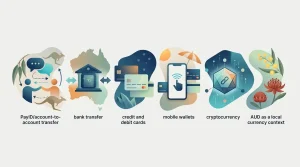
The broader point is that Australians are comfortable moving between cards, mobile wallets and services connected to bank accounts, including PayPal. That flexibility is useful in day-to-day spending. You might pay by tapping a card one moment, use a phone the next, then choose a bank-linked option for an online purchase. There is no single method that defines how everyone pays.
But the ease of switching can create a false sense of continuity. A mobile wallet may hold a card, yet paying with the wallet is not necessarily treated the same as entering the card details directly. A service linked to a bank is another route again. They can look like variations on one simple action—“pay”—while relying on different arrangements behind the screen. The logo is only the start of the story.
This is why I try not to read too much into a familiar payment symbol. Seeing Visa as an everyday card brand does not tell you whether a specific online checkout offers it, whether a phone wallet is available there, or whether a bank-linked service appears as an alternative. Those are separate questions about that particular checkout. General Australian habits can set expectations; they cannot confirm a particular option.
There is also a difference between being accustomed to contactless payments and assuming every kind of transaction should work with a tap. In shops, contactless card payments are widely accepted across Australia. Mobile wallets are also accepted in almost every setting. That broad reach explains why many people are relaxed about switching between a physical card and a phone. It does not mean that every online payment flow works like a shop terminal or presents the same choices.
I find the distinction useful because payment language often makes the options sound more alike than they are. “Card,” “wallet” and “bank transfer” can all appear in the same conversation, but they describe different ways of authorising a payment. When you move from one to another, the experience may change too. A wallet is not automatically a new card, and a bank-linked service is not simply a card with a different name.
So the everyday Australian picture is one of variety rather than loyalty to a single method. People can be comfortable using cards, phone wallets and services such as PayPal, and can switch between them as circumstances change. That flexibility is a habit, not a promise that any particular website will support every route. It’s a small distinction, but one worth keeping in mind whenever a familiar payment method appears in an unfamiliar setting.
No magic shortcut.
“Instant” can describe one part of a payment, not the whole journey. A deposit being processed quickly does not mean a withdrawal will arrive just as quickly. I used to read a fast-payment label as a promise about money coming back, too. It is not.
For Amex, casino deposits are described as being processed instantly. That says something about the deposit transaction; it does not tell you how long a withdrawal takes to clear. A specialist review gives a different timing for Amex withdrawals: they can take up to five days. So even with the same card brand, money going in and money coming out can follow very different clocks.
That gap is the detail I’d pay attention to when you see an “instant withdrawal” claim. Does it refer to the operator processing a request, or to the funds reaching your account? Those are not interchangeable milestones. A request can be handled before the payment has completed its route back to you. The word “instant” sounds tidy. The process may not be.
And Amex timings cannot be used as a calendar for Visa. Visa may be accepted more broadly than Amex at Australian online casinos, but broader acceptance is not evidence of a particular withdrawal speed. It does not establish how quickly a Visa withdrawal is handled or when it will appear in an account. A quick Visa deposit would not settle that question either.
I’d treat any speed claim as a claim about a specific stage, not as a guarantee of the whole transfer. If wording does not make clear whether it means processing or arrival, it leaves out the part you probably care about most. The distinction is easy to miss when a page compresses the whole payment into one cheerful adjective. “Fast” is not a timetable.
This is also why the comparison between deposit and withdrawal matters more than a headline about instant payments. The Amex example shows that an instant deposit can sit beside a withdrawal that takes longer to clear. It does not mean Visa works the same way, nor that every casino applies the same timing. Payment labels alone do not answer those questions.
I would not plan around an instant-withdrawal phrase as if it were a settled arrival time. Read it narrowly: what transaction is being described, and at which point in the process? A deposit speed tells you about money moving in. A withdrawal speed needs to describe money moving out, and ideally say whether the claim concerns processing or clearance. Otherwise, the headline has skipped the useful part.
The practical takeaway is modest, but worth keeping: “instant” on a deposit is not “instant” on a withdrawal. The Amex timing contrast makes that plain, while offering no basis for assigning the same schedule to Visa. Don’t let one fast step stand in for the whole trip.
A Visa logo in a cashier can make an offshore casino look like an ordinary place to pay. It is not. The card brand does not change the rules that apply to online casino services in Australia, and being able to reach a website does not make its offer lawful.
The key law is the Interactive Gambling Act 2001. It prohibits operators from providing online casino games to people in Australia. That restriction is aimed at the operator, rather than explicitly making an Australian player’s use of an offshore site a criminal offence. Those are different things: the absence of an express player offence is not approval, protection or a sign that the service is authorised here.
The Australian Communications and Media Authority (ACMA) oversees enforcement of the Act. So when you see a claim that a casino accepts Visa from Australians, read it as a statement about a payment method, not evidence that the operator may legally offer casino services to people in Australia. A card network and a cashier cannot confer that permission.
That distinction is easy to miss. Payment language tends to be practical: a site says it takes Visa, you see the card option, and the whole arrangement can feel routine. But payment availability answers only a narrow question about how a transaction might be attempted. It says nothing about whether the underlying gambling service is lawful for an operator to provide to Australians. No legal shortcut. No implied approval.
Legal Risk
The Interactive Gambling Act 2001 prohibits operators from offering real-money online casino games to people in Australia, regardless of the payment method used.
There is another consequence worth keeping in view: Australian consumer law does not protect players using offshore casinos. If a dispute arises over an account, a balance or a promised service, you should not assume you can rely on the consumer protections available for an Australian business. The fact that a site is accessible, or that a payment appears to go through, does not create those protections.
I would keep the legal question separate from the card question. “Casinos that accept Visa in Australia” can describe what an offshore site claims to accept; it must not be read as a list of lawful Australian online casinos. Nor does a successful Visa payment show that ACMA has approved the operator. It has not answered that question.
It is the boundary that matters when payment claims are presented as reassurance: the Act restricts operators, ACMA enforces it, and Australian consumer law does not protect people who use offshore casino services. A payment option does not erase any of that.
I used to treat a payment logo as a kind of all-clear: if a site showed my card, I assumed I had a clear picture of what its service offered. That was a bad shortcut. Visa is a way to pay; it does not describe, approve or unlock a catalogue.
The two questions are separate. One is whether an operator displays Visa as a payment option. The other is what services it offers and whether those services are available to someone in Australia. A card logo can answer neither question on its own. It is not a licence, a description of the catalogue, or proof that every part of a site is accessible.
The distinction works in both directions. Seeing Visa listed does not tell you what games are available. Not seeing a particular card does not tell you anything about the games either. Payment acceptance is a decision about how a transaction may be handled; game availability is a separate matter. Muddling them together can make a cashier look more informative than it is.
Card options can also differ from one operator to another. A specialist review has reported that some online casinos do not accept American Express. That is a narrow example of payment-method variation, not a reliable guide to any particular operator today—and it says nothing about which games are offered there. Visa being listed instead would still tell you only about that payment option.
I would not read a payment page as a menu or a promise. It may show a method without explaining the wider service, and a familiar card brand does not change the rules that apply to the service itself. The label is just a label.
That distinction matters especially in Australia. A card payment cannot make a prohibited online casino service lawful or establish that it is available to Australian residents. I keep those questions apart now: payment information is not evidence about game availability, and neither one should be mistaken for approval.
No shortcut here.
A card can be listed as a payment option and still fail at the issuer’s end. That distinction matters: the cashier does not control every decision made by the company that issued the card. A decline therefore does not, by itself, prove that the card details were wrong or that the payment page was unavailable.
There is a specific caution for Amex. Australian banks may block gambling-related transactions on Amex cards at issuer level. That is a possible explanation for a declined payment, not a rule that applies to every bank or every cardholder.
I would not carry that example over to Visa. It says something about Amex restrictions; it does not establish that Australian banks treat Visa the same way, or that a Visa payment will work wherever Visa appears on a cashier. For anyone searching for an Australian casino that accepts Visa, the card brand alone cannot tell you what the issuer will permit.
A payment failure can be frustrating because the screen often gives little useful detail. But guessing at the reason, or repeatedly resubmitting the same transaction, does not reveal whether the issue is an issuer restriction. The card issuer is the party able to explain its own decision; a payment option displayed by a merchant cannot speak for it.
I learned to separate “listed” from “approved”. They are not the same thing.
This is about how card issuers can handle transactions, not a recommendation to use offshore gambling services. Australian law prohibits operators from providing real-money online casino games to people in Australia. The presence of a card logo or a successful card transaction would not change that legal position.
So keep the claim narrow: issuer-level blocking is a known possibility for gambling-related Amex transactions in Australia. It should not be presented as proof of a Visa policy, a universal bank rule, or a guarantee that any particular Australian Visa casino payment will be accepted. A decline is a payment outcome, not a reliable guide to what another issuer or card brand will do.
A card appearing as a deposit option does not mean the same card can receive a withdrawal. I used to treat the two directions as one arrangement; they are separate decisions, and the cashier’s deposit screen tells you little about how winnings may be paid.
Visa is the focus here, but the available Amex detail is a useful reminder not to assume card rules match. A specialist review reports that some casinos may refuse withdrawals to Amex or attach an extra withdrawal fee. It also says an Amex withdrawal requires an earlier deposit made with Amex. Those are Amex-specific conditions, not evidence that a casino with Visa withdrawal follows the same rule.
For Visa, check the withdrawal terms directly rather than inferring them from the deposit menu. Look for whether Visa is accepted for withdrawals, whether the card used for depositing must be the same one, and whether any conditions or fees apply. If the terms do not clearly answer that, the payment option alone is not enough to settle it.
Limits need a separate check, too. A specialist review notes that individual casinos set their own Amex deposit and withdrawal limits, which can vary. That does not establish Visa limits; it shows why a general statement about card payments cannot replace the rules for a particular method and account.
I now separate three things: whether a card can fund an account, whether it can receive a withdrawal, and what limits or charges apply. A “card supported” label only answers the first point unless the operator’s terms explicitly cover the others. Small distinction. Big difference.
For an online casino with Visa withdrawal, read the withdrawal conditions as their own rules, not as a continuation of the deposit process. If Visa is not named there, do not treat its presence in the deposit cashier as confirmation. And if the rules mention Amex, keep that detail in its lane: it cannot establish what happens with Visa.
A cashier can show which payment methods an operator says it supports, but that screen is only a snapshot of its own process. It does not establish that a transaction will be accepted, or that another card will follow the same steps.
A specialist review reports that Amex deposits are available at some Australian online casinos. In the described flow, the customer selects Amex in the cashier, enters the card details and a deposit amount in AUD, then submits the payment. That is a narrow description of one method—not a universal checkout template.
The distinction matters if you are trying to understand a Visa casino payment. A Visa option in a cashier might lead to a similar-looking form, but the Amex example does not verify Visa’s exact screens, required fields or submission process. I would not treat one card’s flow as proof of another card’s acceptance. Looks familiar; isn’t confirmation.
Nor does seeing Visa listed answer every practical question. A displayed option tells you what the cashier presents at that moment. It does not, by itself, confirm that a specific card can be used, or that the transaction will be approved. Those are separate from the visible sequence of selecting a method, entering details and submitting.
I used to read a payment logo as a green light. It isn’t. The useful takeaway from the Amex example is simply how a cashier may present a deposit flow; it cannot tell you which operators accept Visa or guarantee what a Visa checkout will look like. If you encounter a Visa payment method, read the information shown for that method rather than assuming the Amex steps apply. And a payment screen is not an endorsement of the service behind it.
A Visa option in a cashier tells you something about a possible payment route; it tells you nothing about whether a casino bonus is available, who can claim it, or what accepting it would mean. I’ve learned not to treat a bright “welcome” banner as part of the payment terms. The card and the offer are separate matters.
Before acting on a promotion, read its terms directly and check whether the offer is current and applies to your account and chosen payment method. A card transaction is not proof that a bonus has been attached. Nor does a successful deposit settle questions about eligibility, restrictions or how any winnings could be withdrawn. If the wording is unclear, pause rather than assume the cashier will sort it out.
Fees need the same careful separation. A specialist review of Amex payments reports that deposits may be fee-free, while charges can depend on the casino and withdrawals may carry a fee. That is a limited claim about Amex, not a Visa fee schedule and not a reason to choose a promotion. I would check the operator’s own payment and offer terms for the specific transaction instead of carrying a fee claim from one card to another.
“Bonus” sounds like extra value. Read the conditions first. A Visa payment cannot make them better, confirm that an offer exists, or establish that it suits you.
Check the cashier for American Express and read the payment conditions before entering your card details. A listed option does not guarantee that your transaction will be approved.
Some casinos allow Amex withdrawals, but others do not; you generally need to have deposited with Amex first. Withdrawal fees may apply.
Amex deposits typically have no fee, but a casino may add a surcharge, and currency conversion can incur a fee. Withdrawal fees may also apply.
Each casino sets its own Amex deposit and withdrawal limits, so check the limits shown in its cashier or payment terms. Amex limits are usually higher than those for Visa and Mastercard.
Jackpot City Casino, Spin Palace, Ruby Fortune, Ignition Casino, Joe Fortune, and PlayAmo are listed as supporting Amex deposits for Australian players. Acceptance can vary, and Australian law prohibits operators from offering online casino games to Australian residents.
Yes, an Amex gift card can be used for deposits at casinos that accept American Express, but not for withdrawals.