Apple Pay deposit support does not establish how withdrawals work or which games and bonuses a casino offers.
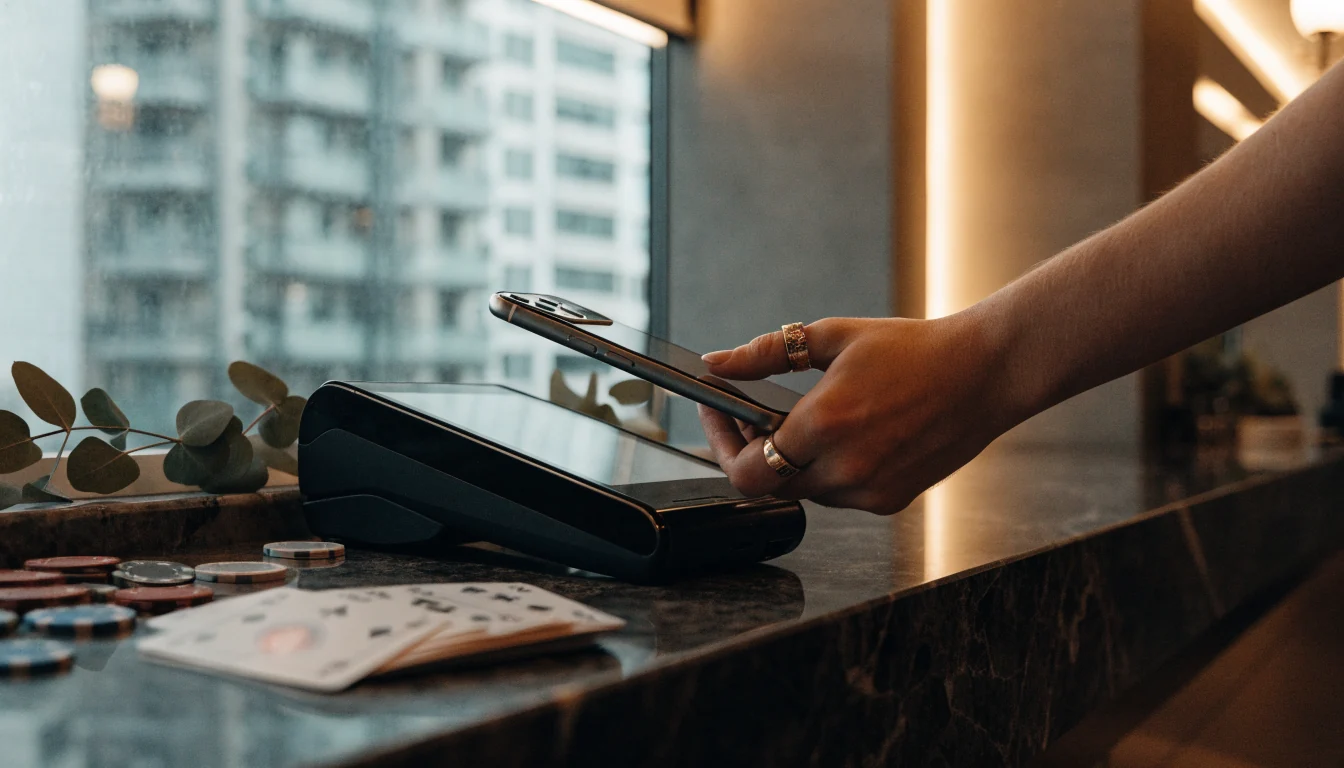
Tap-to-pay is an ordinary part of life in Australia. Contactless credit and debit cards are accepted almost everywhere, and mobile wallets such as Apple Pay and Google Pay are just as familiar in day-to-day shopping. People move between a card, a phone and services linked to their bank, including PayPal, without treating each switch as a big decision.
I do it too. That comfort can make an online payment option feel like it ought to be there simply because the same wallet works at the café or supermarket. But everyday acceptance and an online casino’s payment setup are separate things. Familiarity with Apple Pay across Australia does not establish that a particular casino offers it.
That distinction matters when you’re looking at claims about an Australian casino with Apple Pay. A wallet can be common in the country while a specific website does not support it. A logo, a broad mention of mobile payments or the fact that you use Apple Pay elsewhere is not the same as seeing Apple Pay identified for that service.
If you’re looking for an Australian casino that accepts Apple Pay, check the cashier’s current payment options before signing up: the information here does not confirm Apple Pay availability. The details below provide limited licensing and, where supplied, deposit or payout context.
Bizzo Casino
Bizzo Casino is listed with a Curacao Gaming Control Board license held by TechSolutions Group N.V. The available information does not confirm whether you can deposit with Apple Pay.
Playfina Casino
Playfina Casino is listed as operating under a Curacao eGaming license held by Hollycorn N.V. since 2017, and its minimum deposit is A$20–30 depending on the offer; Apple Pay availability is not specified.
DragonSlots Casino
DragonSlots Casino is listed with a Curacao Gaming Authority license held by Jumpman Gaming Ltd. The available information does not say whether Apple Pay is accepted.
Wild Tokyo
Wild Tokyo has a Curacao license and a stated minimum deposit of A$10. Its listed payout times are 30–60 minutes for crypto and 1–5 days for fiat; Apple Pay availability is not specified.
JustCasino
JustCasino is listed with a Curacao Gaming Control Board license. The available information does not confirm Apple Pay as a payment option.
Roby Casino
Roby Casino is listed as operating under a Curacao eGaming license held by Roby Games Ltd. No Apple Pay details are provided.
Vegaz Casino
Vegaz Casino is listed with Curacao license OGL/2024/1335/0780 and a minimum deposit of EUR 20. The available information does not specify whether you can use Apple Pay.
Rollero Casino
Rollero Casino is listed with Curacao Gaming Control Board license OGL/2023/176/0095, held by Hollycorn N.V. Apple Pay availability is not stated.
SkyCrown
SkyCrown is listed with a Tobique Gaming Commission license and a minimum deposit of A$30. Its stated payout times are around 10–15 minutes for crypto and 1–5 days for fiat; Apple Pay availability is not specified.
Golden Pokies
Golden Pokies is listed with a Curacao license. The available information does not confirm whether Apple Pay is accepted.
I used to blur those things together. If a payment method felt mainstream, I assumed it would carry over; that was a guess, not a check. The habit of switching payment types tells us something about how Australians pay in general, but it cannot answer what a casino accepts.
So the sensible starting point is modest: Apple Pay is familiar to Australian consumers, but that familiarity is not proof of casino acceptance. The name on a phone’s wallet and the options available on a particular site are different pieces of information. Don’t let one stand in for the other.
That’s the distinction.
For a deposit, the useful question is not whether a casino mentions Apple Pay somewhere on its website. It is whether Apple Pay appears as an available option in the cashier for the account and transaction you are looking at. General familiarity with mobile wallets does not answer that. A wallet can be common in everyday Australian payments without being offered for a particular online service.
I’d treat “Apple Pay accepted” as a claim to verify at the point where payment methods are displayed, not as proof that a deposit can be made. A logo in a footer, a general payment-methods page or wording in an advert may describe a service broadly. It does not, by itself, show that Apple Pay is selectable in the cashier. Those details matter because it is the actual payment route—not the label—that determines what you can do at checkout.
 Casinos That Accept Bitcoin in Australia: What to CheckLearn how Australian rules treat Bitcoin-funded casino accounts, what the Interactive Gambling Act 2001 covers, and how to check payment and bonus…
 CashtoCode Casinos in Australia: What to VerifyCashtoCode deposits, withdrawals and bonuses are assessed against the Interactive Gambling Act 2001, which prohibits operators from providing real-money casino-style
The cashier is where a deposit method should be presented as an option. If Apple Pay is not shown there, a mention elsewhere does not establish that you can use it for that deposit. If it is shown, that indicates it is being offered in that interface; it still does not tell you every condition that may apply to a transaction.
I used to read a payment logo as though it settled the whole question. It doesn’t. A method can be named in broad site information while the cashier gives a different picture. The practical distinction is simple: a claim says a method is supported; a displayed, selectable option is evidence of what the cashier is offering at that moment.
That distinction also avoids assuming that the same payment choice is available to everyone. The relevant screen is the one attached to the account and deposit process in question, rather than a generic description aimed at an unspecified audience. I would not take a wallet’s popularity, a familiar phone interface or a payment logo as a substitute for that check.
There is another step that can sit between opening a cashier and making a financial transaction: identity checks. Online casinos commonly require customers to undergo a Know Your Customer assessment before they can carry out financial transactions. In practical terms, seeing a payment method does not mean an account is ready to transact. The operator may still require information or documents to establish the customer’s identity.
Attention: Seeing a payment method in the cashier does not mean your account is ready to transact; you may still need to complete identity checks first.
That is worth separating from the payment question. Apple Pay appearing in a cashier would address whether the method is presented there; it would not mean that identity checks have been completed or that a transaction has been approved. Likewise, completing an identity assessment would not prove that Apple Pay is available. They are separate parts of the process.
I would avoid treating a screen as a promise that money will move. A payment option is one thing; account verification and acceptance of a transaction are another. Keep those stages distinct.
A search for a small Apple Pay deposit can make it tempting to expect a particular minimum. But a phrase such as “$10 deposit” is not evidence that a cashier accepts that amount, or that Apple Pay is available at all. Unless the cashier itself states the applicable amount for the selected method, there is no sound basis for assuming a minimum.
The same goes for speed. Seeing Apple Pay listed does not establish how quickly a deposit will be processed. I would not translate the quick feel of using a phone wallet in a shop into a promise about an online transaction. The interface, identity checks and transaction decision are separate matters, and a displayed option alone does not settle timing.
“Instant” sounds reassuring. It is still just a word unless it is tied to a clear, relevant payment term—and even then, the wording needs to match the transaction being described. Don’t fill in missing details from what you know about contactless payments elsewhere.
 Casinos that accept PayID in Australia: what to checkLearn how to assess PayID claims, distinguish deposits from withdrawals, and understand the legal limits: Australian consumer law does not protect offshore…
 Casinos That Accept Neosurf in Australia: What's VerifiedLearn why Neosurf availability cannot be assumed, how withdrawal routes differ from deposits, and how the Interactive Gambling Act applies to online…
When assessing whether Apple Pay is being offered for a deposit, keep the question narrow: is it presented as a selectable payment method in the cashier? Then distinguish that from the other things a cashier may not establish on its own, including whether identity checks are complete, whether a transaction will be accepted, and what amount or timing applies.
That approach does not identify a “best” option or confirm that any particular casino supports Apple Pay. It simply keeps a payment claim from being mistaken for a working deposit route. A familiar wallet is not the same as a visible cashier option, and a visible option is not the same as a completed transaction.
That’s the check.
A page can say “Apple Pay accepted” in a headline and still leave you unsure what that means in practice. I’ve learned not to treat a payment logo or a broad claim as confirmation. The useful question is narrower: does the cashier actually show Apple Pay as an available option for the user in front of it?
That distinction matters because a claim on a review page is not the same thing as an option presented during a transaction. A description may be old, general, or based on a payment method being available somewhere rather than to every customer. Until you can see what the cashier offers, the wording alone doesn’t settle the point.
When assessing a claim, look for Apple Pay named plainly among the available payment methods. A generic mention of “mobile payments” does not tell you which wallet is supported. Nor does a page that lists card payments establish that a particular card stored in Apple Pay will work there.
I try to separate three things that promotional copy often bundles together: a service being popular, a payment brand being mentioned, and a specific method being available in the cashier. Only the last one answers whether that method is being offered in that setting. The rest is background.
If the wording is vague, don’t fill the gap yourself. “Supports digital payments” could mean several things. “Apple Pay” in a general list is clearer, but it still may not show what is available to an individual user. The cashier is where the claim becomes concrete—or doesn’t. Plain enough.
A specialist review has reported that Visa may be accepted at more Australian online casinos than American Express. That comparison is about those card methods; it does not establish anything about Apple Pay. Payment methods are not interchangeable just because they can all be used to move money in other settings.
That is an easy leap to make. If one card brand appears widely, it can feel reasonable to assume a mobile wallet linked to a card will be treated the same way. But a wallet can be listed separately, or not appear at all. The presence of Visa, Amex, or another card option cannot confirm Apple Pay support.
The same caution applies to a site-wide badge, a paragraph that says “multiple payment options,” or a list copied into several pages. Those details may point you toward what to check, but they don’t replace the cashier’s actual options. Read the exact wording, then compare it with what is shown there. No guesswork required.
 Casinos That Accept POLi in Australia: What to KnowThe guide explains why a POLi payment label does not make real-money casino games lawful in Australia, and which claims remain unverified.
 Casinos That Accept Tether USDT in AustraliaLearn why a USDT label does not confirm Australian availability, an active deposit method, network support, or matching withdrawal options.
A credible check should not make you infer more than the statement says. If a page refers to Apple Pay but does not show it as an option, that is a claim to verify, not a settled answer. If the cashier lists it, that establishes that it is being offered there at that point; it does not, by itself, prove that every other payment question has the same answer.
I also pay attention to whether the language is precise. “Apple Pay available” is more useful than “fast, flexible payments,” because the latter tells you almost nothing about the method. Words such as “best” or “instant” are not evidence either. They’re selling words. I’ve made the mistake of reading confidence as confirmation. It isn’t.
This is not about compiling a league table or trusting whichever page sounds most certain. It is about matching a specific statement to a specific option, without letting a comparison about cards stand in for evidence about a wallet. If the claim and the cashier do not line up, the claim has not answered the question.
A payment label can make a site look ordinary: Apple Pay is familiar, the cashier may look polished, and the page may use Australian dollars. None of that changes the legal position. For people physically in Australia, the key issue is not which wallet a site says it accepts. It is whether an operator is allowed to provide online casino games to them.
Legal Risk
The Interactive Gambling Act 2001 prohibits operators from offering real-money online casino games to Australian residents.
The Interactive Gambling Act 2001 prohibits operators from offering real-money online casino games to Australian residents. That covers the service being offered; it does not explicitly make a player’s use of an offshore casino a criminal offence. I used to blur those two points together: if players were not expressly criminalised, I assumed the whole arrangement must be acceptable. That is not what the law says.
The distinction matters. A rule directed at operators is not permission for an operator to serve Australian customers. Nor does the absence of an explicit player offence turn an offshore site into a locally authorised service. The law sets limits on what providers can offer, even when a website is visible and its payment options appear familiar.
The Australian Communications and Media Authority, or ACMA, is responsible for enforcing the Act. Its role is part of the legal context, not a stamp of approval for any casino or payment method. Seeing an Apple Pay logo, or a claim that a casino takes Apple Pay, tells you nothing about whether the service is lawful for people in Australia.
There is another practical distinction that is easy to miss. Australian consumer law does not protect players who use offshore casinos. If there is a dispute over an account, a payment, or a withdrawal, you should not assume the protections and remedies available with Australian businesses will apply. The site may present familiar branding and local currency; that does not give it the same status as a domestic service.
That is the part I would keep in view when reading claims about casinos that accept Apple Pay in Australia. Payment convenience and legal status are separate questions. A wallet does not make a prohibited offering lawful, and a casino’s claim about its cashier does not provide consumer protection.
No shortcut here. The law is about the operator’s service, while the payment method is just one part of how a site may handle transactions. Understanding that boundary is more useful than treating a familiar checkout option as evidence that the overall arrangement is safe or locally protected.
A payment logo and a game catalogue answer different questions. Even if a cashier displays Apple Pay, that alone would tell you only that the payment option is presented there. It would not establish which games are offered, whether the same payment route applies to them, or whether a particular game can be funded that way.
I used to treat a payment badge as a kind of all-purpose confirmation: method accepted, therefore everything else must line up. That leap is too big. Payment information can describe how a transaction is handled; it does not, by itself, describe the content available after someone signs in. The phrase “Apple Pay casino games” can sound like one combined feature, but it bundles together separate details that need separate confirmation.
There is also a step before any financial transaction: online casinos generally ask customers to complete identity checks, often called a Know Your Customer assessment. That requirement concerns verifying the customer. It does not tell you what games are available or whether Apple Pay is connected to any particular game.
Online casinos generally require customers to undergo a Know Your Customer (KYC) assessment to verify their identity before financial transactions can occur.
So if a page mentions Apple Pay alongside casino games, read the wording narrowly. Is it describing a payment option, or making a specific claim about game access? Those are not interchangeable statements. A list of payment methods cannot stand in for a game catalogue, and a game description cannot prove that a payment method is supported.
I would keep the two questions apart: what payment methods are shown, and what games are described? Unless both are clearly addressed, one answer should not be used to fill in the other. That is less exciting than a neat promise that everything works together, but it is a more careful reading.
The practical point is simple: Apple Pay information alone does not identify any game that can be paid for with it. Nor does it establish that a mobile casino experience has a special Apple Pay connection. A payment label is not evidence of a game-level feature. Separate claims need separate support.
A payment method appearing at the deposit stage tells you how money may be sent in. It does not, by itself, tell you how a later payout would be handled. I used to read a familiar logo as a complete promise: pay this way now, get the money back the same way later. That shortcut is not reliable.
Deposits and withdrawals are separate transactions. A deposit is initiated by the customer through the cashier; a withdrawal is a request to release funds, subject to the operator’s payment process. The fact that one direction works does not establish that the reverse direction is supported, or that it would use the same route. The distinction matters even when the payment method is Apple Pay.
So if Apple Pay is shown for a deposit, treat that as information about the deposit option only. Don’t silently extend it into a claim that an Apple Pay cash-out is available, let alone that it would arrive instantly. “Instant” is a strong word; it needs to describe the particular transaction, not just one part of the payment journey.
Amex offers a useful comparison, but not a forecast for Apple Pay. A specialist review reports that Amex casino deposits are processed instantly, while an Amex withdrawal can take up to five days to clear. Those are different timings for the same payment brand, and they do not establish Apple Pay processing times. The point is the gap between paying in and receiving money out. Different direction, different clock.
That is why I separate three things when reading a payment claim: whether a method is shown for deposits, whether it is available for withdrawals, and how long each transaction takes. One statement cannot stand in for the others. A deposit option does not settle the withdrawal question, and a timing claim for one method cannot be carried across to another.
There is also a practical difference in what you are checking. Before a deposit, the cashier may show the payment choices available for that transaction. A withdrawal involves its own request and processing stage. Seeing Apple Pay on the first screen should not lead you to assume it will appear again when you want to cash out. Keep the claim narrow.
I learned to distrust tidy labels like “instant withdrawals.” They can blur together the deposit, the withdrawal request, and the time it takes for a payment to clear. Those are not interchangeable events. If a claim does not make clear which one it means, it tells you less than it sounds like it does.
For Apple Pay, the sensible reading is modest: a deposit option, if presented, concerns money going in. It is not a promise about money coming back, the route used, or the time involved. And the Amex comparison stays just that—a comparison, not an Apple Pay timetable. Don’t let one familiar payment logo do the work of three separate answers.
A casino’s rules for taking money in may differ from its rules for sending money out. That distinction matters when you are checking whether a particular payment method works both ways. A deposit option in the cashier does not, by itself, tell you whether withdrawals can be returned to that same method.
A specialist review reports that some Australian online casinos do not permit withdrawals to American Express. Treat that as a policy that can differ between operators, not a rule that applies across the market. It also says individual casinos set their own Amex deposit and withdrawal limits, which can vary. The cashier’s terms and withdrawal rules are the relevant details to check; a general statement about payment support cannot settle them.
Apple Pay needs the same careful distinction. A mention of Apple Pay as a payment option does not establish that an online casino supports withdrawals to Apple Pay, or that it sends funds back through the method used for a deposit. Those are separate policy questions. I used to read a payment logo as an all-purpose promise. It isn’t.
When reviewing any stated withdrawal rule, look for whether it names the payment method, whether it specifies a return-to-source requirement, and whether separate limits apply to withdrawals. If the wording only describes deposits, don’t stretch it into a claim about cashing out. If the rules are unclear, the claim is unclear. Simple as that.
This is also why comparisons between payment methods can mislead. A rule reported for Amex tells you about Amex, not Apple Pay. Nor does a casino’s general withdrawal policy prove that every payment route is available for payouts. The method-specific terms matter, and they may not match the deposit options.
So the useful question is not merely whether a casino mentions Apple Pay, but whether its withdrawal terms expressly cover it. Without that detail, you cannot infer Apple Pay withdrawal support from another payment method’s rules—or from a broad statement that a cashier accepts mobile payments. No assumption fills that gap.
A payment label and a game catalogue answer different questions. Even if a casino presents Apple Pay as a way to fund an account, that does not tell you which titles are offered or whether the payment method applies to a particular title. I used to read a payment badge as if it described the whole service. It doesn’t.
Attention: A payment label does not identify which specific games or slots are available, nor does it prove a payment method applies to a particular title.
That distinction matters when a page pairs Apple Pay with references to pokies or particular games. The wording can make the two seem connected, when it may only be describing a general account payment option. A claim about Apple Pay support, on its own, is not a list of games and says nothing specific about individual titles.
I’d treat any “Apple Pay pokies list” as a claim that needs two separate pieces of clarity: what payment function is being described, and what game information is actually being provided. If the wording only says Apple Pay is accepted, it does not establish a game-by-game connection. If it names games but says nothing about payments, that does not establish Apple Pay support either.
The difference is easy to miss when a page compresses both ideas into a headline. “Apple Pay slots” sounds precise; it can still leave the underlying relationship unclear. Marketing shorthand is not a payment rule.
So I wouldn’t use an Apple Pay claim to infer which games are available, or use a list of games as proof of a payment option. Those are separate claims, and each needs to be read for what it actually says. No shortcut there.
A mention of a bonus alongside Apple Pay can make the two sound connected. I’ve learned not to treat that wording as payment information. A promotion describes an offer; by itself, it does not show which payment methods are accepted or whether Apple Pay is among them.
The distinction matters because “Apple Pay bonus” could mean several things in casual wording: a bonus discussed on a page about Apple Pay, an offer supposedly associated with paying that way, or simply two separate details placed together. Without clear terms tying them together, the phrase leaves the important part unanswered.
I would separate the claims. Does the text actually state that Apple Pay is accepted, or does it only mention a bonus? Does it explain any payment conditions, or is the wallet’s name just near the promotional language? Those are different statements, and one cannot stand in for the other.
I’m wary of words like “exclusive” when they appear without a precise explanation. “Exclusive” sounds like a perk; it does not identify a payment method. Nor does a bonus banner, a headline, or a short promotional description establish what the cashier supports.
So if you see a casino bonus described in connection with Apple Pay, read it as a promotion claim only. It does not confirm that you can pay by Apple Pay, and it says nothing reliable about the payment’s terms. The cashier’s listed options are the relevant evidence for acceptance, not the presence of bonus language. Keep those two questions apart. A bonus mention is not payment confirmation.
Payment information is easy to overextend. A report about one card can sound like a clue about mobile wallets, and a general statement about casino fees can be mistaken for a rule that applies to every method. I have made that leap before: I saw a familiar payment logo and assumed the rest of the checkout would work much the same way. That is not a safe assumption.
Australian consumer law does not protect players who use offshore casinos, regardless of the payment methods used or the currency displayed.
A specialist review reports that Amex deposits at casinos may carry no fee, while also noting that charges depend on the casino and a withdrawal may incur a fee. That is a narrow statement about Amex, not a standard applying across Australian online payment options. It says nothing about Apple Pay pricing. The costs attached to one payment method cannot establish whether another method is available, what it costs, or what conditions apply.
The distinction matters because Apple Pay is not interchangeable with Amex. It is a wallet through which a supported card may be used; the underlying card issuer and the casino’s own payment arrangements can still matter. Even if a casino accepts a particular card directly, that does not establish that its cashier offers Apple Pay. Nor does a reported Amex fee arrangement tell you whether an Apple Pay transaction would be treated as a card payment, declined, or subject to different terms. Those are separate questions.
So a claim about an Australian online casino accepting Apple Pay needs to stand on its own. Evidence about Amex deposits, withdrawals or charges does not substantiate it. The same applies to claims about a mobile casino, online pokies or a “best” option: wording that puts Apple Pay beside those terms is not, by itself, proof of a payment feature. Familiar labels can make a claim sound complete when the important detail is still unestablished.
The reverse inference is just as shaky. An Amex fee report does not show that Apple Pay is unsupported; it simply cannot settle the question either way. It would be wrong to turn a lack of information into a definite yes or no. What matters is whether Apple Pay is actually identified as a payment choice and whether the stated terms refer to that method, rather than to another card or wallet.
Fees also need to be kept in their proper lane. “No fee” in a report about Amex deposits does not mean every casino applies no charge, because the same report says casino conditions can differ. It also does not cover possible withdrawal fees. And none of those details can be carried over to Apple Pay without evidence specific to Apple Pay. A payment method’s name is not a fee schedule.
There can be more than one party involved in a payment: the operator, the wallet provider, the card issuer and the bank. Their roles are not necessarily identical, and a charge or decline at one point does not tell you how the others handle another method. That is why broad descriptions such as “wallet accepted” or “card payments available” should not be stretched into a promise about every card stored in a wallet. The details have to match the method being discussed.
I would also separate a payment claim from an endorsement. Calling something the best Australian online casino with Apple Pay implies that the underlying payment support has been established, and that the comparison itself has a sound basis. Payment wording alone cannot do either job. A polished label is still just a label until it matches an actual, clearly stated payment option and its terms. Marketing gloss is not evidence.
There is a larger Australian context worth keeping in view: Australian consumer law does not protect players who use offshore casinos. That does not turn an uncertain payment claim into a reliable one, and it does not make an offshore service an authorised local option. Payment details and legal protections are different issues, but both matter when assessing what a claim can—and cannot—tell you.
My takeaway is modest: treat Amex fee reporting as Amex information, and Apple Pay claims as something that needs Apple Pay-specific support. Don’t read one method’s fees, availability or conditions across to another. And don’t let a familiar wallet name make an uncertain offer feel settled. The boundaries matter.
Limits are set by each casino and can vary. Amex limits are usually higher than the limits for Visa or Mastercard.
Jackpot City Casino, Spin Palace, Ruby Fortune, Ignition Casino, Joe Fortune and PlayAmo are among the operators that accept Amex deposits for Australian players.
Amex deposits typically have no fee, but some casinos may add a 1.5% surcharge, and Amex cards incur a 3% currency conversion fee. Check the cashier for charges that apply to your transaction.
Some casinos do not allow withdrawals to Amex, and you generally need to have deposited with Amex first. Withdrawal fees may also apply.
Check the casino cashier and select Amex if it is offered. You can then enter your card details and deposit amount in AUD before submitting the payment.
Look for Amex as a selectable option in the casino’s cashier. A casino may not accept it, and Amex or your Australian bank may block a gambling transaction.
Amex may block payments to a particular website, and Australian banks may also block gambling transactions on Amex cards. Some casinos do not accept Amex in the first place.